FDM vs SLA vs SLS 3D Printing: Which Technology Should You Choose for Your Project?
Jun 23 2026
Choosing a 3D printing technology looks simple. It isn't, and most teams find that out the hard way.
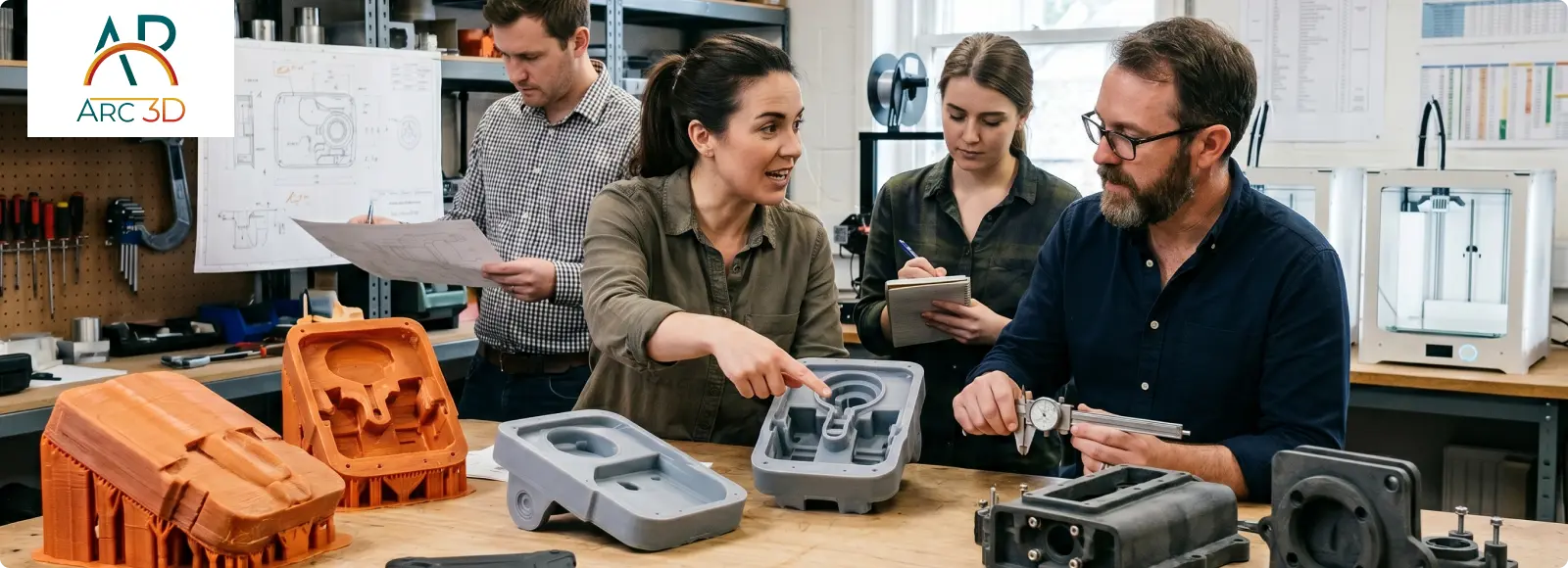
Here's the problem. One week you need a rough prototype by Friday. The next, you need a part that won't crack under load. And sometimes you need a model so clean it could sit on a shelf next to the real product. Those are three different jobs, and each one wants a different printing method. Get it wrong, and you've burned time, money, and a part that flat-out doesn't work.
3D printing has crept into the way UAE businesses operate, often without much fanfare. Dubai startups use it to push products to market faster. Industrial teams in Abu Dhabi test parts before they ever spend on tooling. Architects, doctors, engineers, plenty of others- all of them lean on it day to day. The reason comes down to two things: it saves time, and it makes getting something wrong a lot cheaper to fix.
Which is why one question keeps landing in our inbox. FDM, SLA, or SLS- which one should I actually use?
They all build a part layer by layer, so at a glance they look interchangeable. They're not. The material is different. So is the strength, the detail, the finish, and the price. Pick the wrong process, and you don't just spend more than you had to. You can end up with a part that fails the exact test you built it for.
This guide lays out FDM vs SLA vs SLS in plain language. No jargon, no hand-waving. Just what each one is good at, where it falls short, and the kind of calls we run into on real projects, so you can choose without second-guessing yourself.
Quick Answer: FDM vs SLA vs SLS
Go with FDM for cheap prototypes, big concept models, or when you want toiterate fast.
Go with SLA when fine detail and a smooth, show-ready finish are the whole point.
Go with SLS when the part has to be strong, do a realjob, and hold up in end use or a small production run.
Whichever of those three matters most to your project is usually your answer.
FDM stands for Fused Deposition Modeling, and it's the one most people picture when they think "3D printer." That machine you've seen slowly tracing out an object in thin plastic lines? That's FDM.
The idea behind it is almost boringly simple. A spool of plastic filament feeds into a hot nozzle, melts, and gets laid down in layers that fuse as they cool. That simplicity is the whole reason FDM costs less than the rest, and it's why so many teams reach for it first when they just need a prototype in hand.
Materials are where FDM really stretches. On our own machines, we run PLA, ABS, PETG, Nylon, and carbon fiber reinforced filaments, plus ETPU, an elastic TPU we use when a client needs flexible, shock-absorbing parts to test. That spread takes you from a throwaway concept model all the way to a tough functional part. It's also why FDM printing applications turn up almost everywhere: product development, consumer goods, manufacturing, architecture, education, and automotive prototyping. The workhorse.
The catch is finish. You trade a bit of polish for all that speed and savings. You'll see layer lines, the surface quality is lower, fine detail isn't its strength, and how strong the part is depends on how well those layers bonded. For early work, though, nobody really minds.
Example: When ARC 3D builds large architectural massing models or big masterplan bases, FDM does the heavy lifting, because its large build volume lets us print sizeable sections affordably before the detailed, client-facing work begins. A startup shaping a new product housing can do the same thing on a smaller scale, printing four or five versions in a week to get the feel right before spending on anything fancier.
Pros of FDM:
Cons of FDM:
Learn More: What Is Fused Deposition Modeling? A Complete 3D Printing Guide
SLA, short for Stereolithography, works on a completely different principle. Instead of melting plastic, it uses a UV laser to cure liquid resin inside a vat. Light hits the resin, the resin hardens, and a solid layer forms. The payoff is detail the other two simply can't touch.
Mechanically, the part grows inside that tank of resin. The laser cures one layer, the platform lifts, the next layer forms, and so on. Because the laser can pick out microscopic features, SLA has a reputation as one of the most accurate 3D printing technologies going.
On the resin side, we keep a fairly wide shelf: standard, clear, engineering, castable, and biocompatible resins, each chosen for a specific job rather than as an all-rounder. That accuracy and material range is why SLA printing services Dubai teams pull it out for dental models, medical devices, jewelry patterns (the castable resins are built for exactly that), presentation models, and design validation prototypes. If a part has to look finished or carry some delicate little feature, SLA is usually where you land.
Example: A dental lab producing surgical guides and crown models needs accuracy down to a fraction of a millimeter and a finish clean enough to use clinically. SLA handles that with biocompatible resins made for the purpose. The same strengths are why a jeweller reaches for it to print intricate castable patterns ready for casting.
Pros of SLA:
Cons of SLA:
Learn More: What Is SLA 3D Printing? Complete Stereolithography Guide
SLS, or Selective Laser Sintering, is what you choose when the part has to actually do something. A high-powered laser fuses powdered material, nearly always nylon, into solid layers.
And here's the part that makes it special. FDM and SLA both need support structures. SLS doesn't, because the loose powder around the part props it up as it builds. A thin layer of powder gets spread, the laser fuses exactly where it should, fresh powder goes on top, repeat. That self-supporting trick is what lets SLS pull off complex shapes, interlocking pieces, and even moving parts printed in a single piece, geometry that would tie the other two in knots.
We run SLS in PA12 and PA11 nylon, glass-filled nylon for extra stiffness, and a flexible TPU powder. So SLS printing services UAE providers reach for it on functional prototypes, aerospace components, automotive parts, medical devices, and manufacturing tooling. These aren't stand-ins for an idea. They're parts you can put to work.
Example: One of ARC 3D's most demanding builds was a fully 3D-printed moving cutaway of a T700 turboshaft engine for a defence client. It had to capture intricate internal geometry and actually move, the kind of single-piece complexity SLS and additive processes handle that traditional methods struggle with. The same strengths apply to a custom nylon bracket and air-duct assembly that has to survive heat and vibration on a test rig.
Pros of SLS:
Cons of SLS:
Learn More: What Is Selective Laser Sintering (SLS)? A Complete 3D Printing Guide
| Feature | FDM | SLA | SLS |
|---|---|---|---|
| Printing Process | Extrudes melted filament | Cures liquid resin using UV light | Fuses powder using a laser |
| Material Type | Thermoplastic filament | Photopolymer resin | Nylon powder |
| Surface Finish | Visible layer lines | Extremely smooth | Matte and slightly textured |
| Accuracy | Good | Excellent | Excellent |
| Strength | Moderate | Moderate | High |
| Production Speed | Fast | Moderate | Fast for batch production |
| Cost | Low | Medium | Higher |
| Supports Required | Yes | Yes | No |
| Best Use Cases | Concept models, prototypes | Detailed models, dental applications | Functional parts, manufacturing |
Learn More: FDM vs SLA vs SLS: Choose Best 3d Printing Technology in UAE
On finish alone, SLA wins, and it isn't a close call. Parts come off the printer looking almost injection-molded, which is exactly what saves you when a client picks one up and starts turning it over in their hands.
FDM is the opposite story. The layer lines show, so before it looks presentable, you're usually sanding, priming, painting. SLS lands in between. Its matte texture is fine as-is for working parts, and you can smooth or dye it when appearance starts to matter.
Post-processing follows from all that. FDM: sand and paint. SLA: wash and UV cure. SLS: clean, finish only if you want to. We've seen that one finish gap decide an entire project when the part was headed into a boardroom.
If detail is the whole point, accuracy jumps to the top of the list. SLA holds the tightest tolerances and reproduces the smallest features best. SLS is close behind and keeps its dimensions honest even on big, awkward parts. FDM is moderate, and honestly that's fine for most general work.
Where it bites is healthcare, aerospace, electronics, and product design. Anywhere a millimeter off means two parts refuse to mate. That's the reason engineering prototype services Dubai teams reach for SLA and SLS on anything that has to be tested or assembled, and leave FDM for the jobs where speed wins.
Materials are probably the clearest dividing line of the lot.
FDM 3D printing supports a wide range of thermoplastic materials suitable for different applications:
SLA printing uses liquid photopolymer resins that deliver exceptional detail and smooth surface finishes:
SLS technology primarily uses powdered nylon-based materials known for their durability and functional performance:
This is the section that matters when a part has to take a load or pass a test. Put SLS vs FDM head to head and SLS takes it, mainly because its parts are isotropic. Plain version: they're just as strong whichever direction the force comes from.
That's the reason functional prototype manufacturing leans on SLS so heavily. The parts shrug off real abuse. As a quick rule, FDM is fine for basic functional parts, SLA is better kept to things you only need to look at, and SLS gives you something you can genuinely treat as a finished, working component.
Totally depends on the job. One concept part needed today? FDM is hard to beat. A batch of fifty? Now SLS rewrites the math. With no supports to print, you can stack a build full of parts and sinter them all in one go, which is where SLS quietly pulls ahead. So FDM owns the one-offs, SLA sits in the middle, and SLS is the one you want once volume enters the picture.
Cost makes more sense in layers than as a single figure.
Machines: FDM cheapest, SLA is middle, SLS dearest.
Materials: filament is cheap, resin sits in between, SLS powder is premium. After that it's all volume, complexity, and material.
The number that actually settles it is cost per part for your specific job. One simple prototype? FDM, almost every time. A short production run? SLS can flip to cheaper despite the higher setup, because that cost spreads across a packed build. So the "cheapest technology" in the abstract is rarely the cheapest one for what you're making, which is the whole reason a five-minute conversation about requirements usually saves money.
Recommended: FDM. It's cheap, quick, and easy to tweak between versions, so you can run several design rounds without the costs creeping up.
Example: A Dubai startup working on a new consumer electronic device can print several prototype versions in a single week with FDM, checking dimensions, ergonomics, and assembly before spending on anything more advanced.
Recommended: SLA. When looks and precision are critical, that smooth finish and fine detail make it ideal for stakeholder reviews and investor pitches.
Example: A product company prepping for a trade exhibition can use SLA to print a presentation-ready prototype that looks close to the finished product, so investors and customers actually get the design.
Recommended: SLS. This is for parts that have to work under real conditions, not just look the part.
Example: That T700 turboshaft cutaway ARC 3D produced for a defence client is the extreme version of this: intricate internal geometry and moving sections in a single build. The everyday version is checking snap-fit features and load-bearing brackets on a mechanical assembly before committing to production.
Recommended: SLS. It makes small batches without the cost of traditional tooling.
Example: A startup launching a specialized industrial product can run off production-grade parts in limited quantities with SLS, keeping upfront spend down while getting to market faster.
Recommended: SLA. It brings the precision and fine detail healthcare work demands, with biocompatible resins for clinical use.
Example: Dental labs routinely use SLA for highly accurate models used in aligners, treatment planning, and patient conversations.
Recommended: SLS. It delivers the strength, stability, and design freedom these sectors need.
Example: Alongside the T700 engine, ARC 3D has built an F-16-inspired aerospace display model and an oil and gas operational model for the National Guard, the kind of detailed, functional work where SLS and additive processes earn their place.
Different sectors here gravitate toward different technologies, depending on what the work asks for. We see this play out across our own projects.
Scale models, presentation models, and urban planning models do a lot of the heavy lifting when you're trying to win approval. SLA brings the presentation-quality finish for detailed showcase pieces, and FDM handles the big conceptual models without blowing the budget. Most polished architectural models use both.
Example: ARC 3D's illuminated Sheikh Zayed Grand Mosque model, shown at Make it in the Emirates and visited by H.E. Sheikh Nahyan bin Mubarak Al Nahyan, and a detailed Al Ghurair factory model complete with interiors, are exactly this blend of big-form printing and fine, client-facing detail.
The work here is functional prototypes, production tooling, and assembly fixtures, where strength and repeatability rule. SLS is the pick.
Example: A manufacturer building a custom production fixture can use SLS for durable tooling that survives repeated use on the floor.
Anatomical models, surgical planning aids, and device prototypes all need fine detail and accuracy, so SLA is the default, helped by biocompatible resins.
Example: Healthcare providers can use SLA anatomical models to plan complex procedures and explain them more clearly to patients.
Custom components, functional test parts, and validation models lean on SLS for durability and complex geometry.
Example: Engineers can produce custom brackets, air ducts, and test components with SLS that behave like the real thing under real conditions.
This is usually a journey through all three: FDM for early validation, SLA for investor presentations, SLS for functional and small-batch production. The same toolkit handles creative work too.
Example: ARC 3D's large-scale Hulk figure for the collectibles and entertainment space shows how these processes scale up for props and display pieces, not just engineering parts.
FDM is the right shout for budget-tight projects, large parts, concept models, and fast prototyping- basically any time iterating quickly beats a flawless finish.
Pros:
Cons:
For early-stage work and big, simple shapes, that trade is tough to argue with.
SLA earns its keep on high-detail prototypes, presentation models, medical work, and anything with fine features that demand precision.
Pros:
Cons:
When a part has to look right or hold tiny features, it's a trade worth making.
SLS is your technology for functional parts, production runs, complex geometries, and demanding engineering jobs.
Pros:
Cons:
When performance is the priority, SLS is usually the safe bet.
| If You Need | Recommended Technology |
|---|---|
| Lowest cost | FDM |
| Fastest iteration | FDM |
| Large concept models | FDM |
| Best surface finish | SLA |
| Highest detail | SLA |
| Medical and dental models | SLA |
| Functional testing | SLS |
| Production-ready parts | SLS |
| Low-volume manufacturing | SLS |
| Complex geometries | SLS |
| Architectural presentation models | SLA |
Knowing the difference between FDM, SLA, and SLS gets you halfway. Having all of them on hand, plus someone who can match the right one to your job, gets you the rest of the way. That's the combination ARC 3D brings.
ARC 3D is a 3D printing & model making company in UAE, providing 3d printing service in dubai, abu dhabi, sharjah, works with multiple additive manufacturing technologies, including FDM, SLA, SLS.
Ensuring each project is matched with the process that best balances performance, appearance, lead time, and cost. Rather than pushing a single technology, the team focuses on selecting the right solution for the job.
It also means a real conversation before anything prints. The team weighs your strength requirements, how the part needs to look, how it has to perform, and your budget, then points you to the process and material that hit all four at once. The track record backs it up: more than 50,000 parts delivered, over 2,000 clients served, and work shipped across 10 countries in around four years, including projects for the Ministry of Defence, Emaar, Miral, Al Ghurair, and Modon.
Speed comes built in. ARC 3D handles rapid prototyping services for UAE projects, the engineering prototype services Dubai teams count on, and industrial 3D printing service production, with reliable delivery across Dubai, Abu Dhabi, Sharjah, and the rest of the UAE.
The work covers architecture and construction, automotive, aerospace, defence, manufacturing, healthcare, consumer products, and product design startups, with the right technology picked for each. And since the support runs end to end, from 3D modeling and design optimization through prototyping, functional testing, and small-batch manufacturing, your idea can go from concept to finished part with one partner instead of a chain of vendors.

Compare FDM vs SLA vs SLS honestly, and you reach a slightly anticlimactic answer: none of them wins across the board. It all comes down to what you need the part to do.
Pick FDM when affordability and fast prototyping lead. Pick SLA when looks, precision, and a presentation-ready prototype are the priority. Pick SLS when strength, durability, and real performance can't be compromised.
As additive manufacturing in the UAE keeps growing, more businesses are using all three across the life of a single product. A concept might start as a quick FDM model, mature into a refined SLA prototype, and finish as SLS parts for functional testing and production. Knowing where each one fits is what lets you spend less, move faster, and actually get the result you were after.
Still not sure which one suits your application? Start conversation with ARC 3D's experts usually clears it up fast.