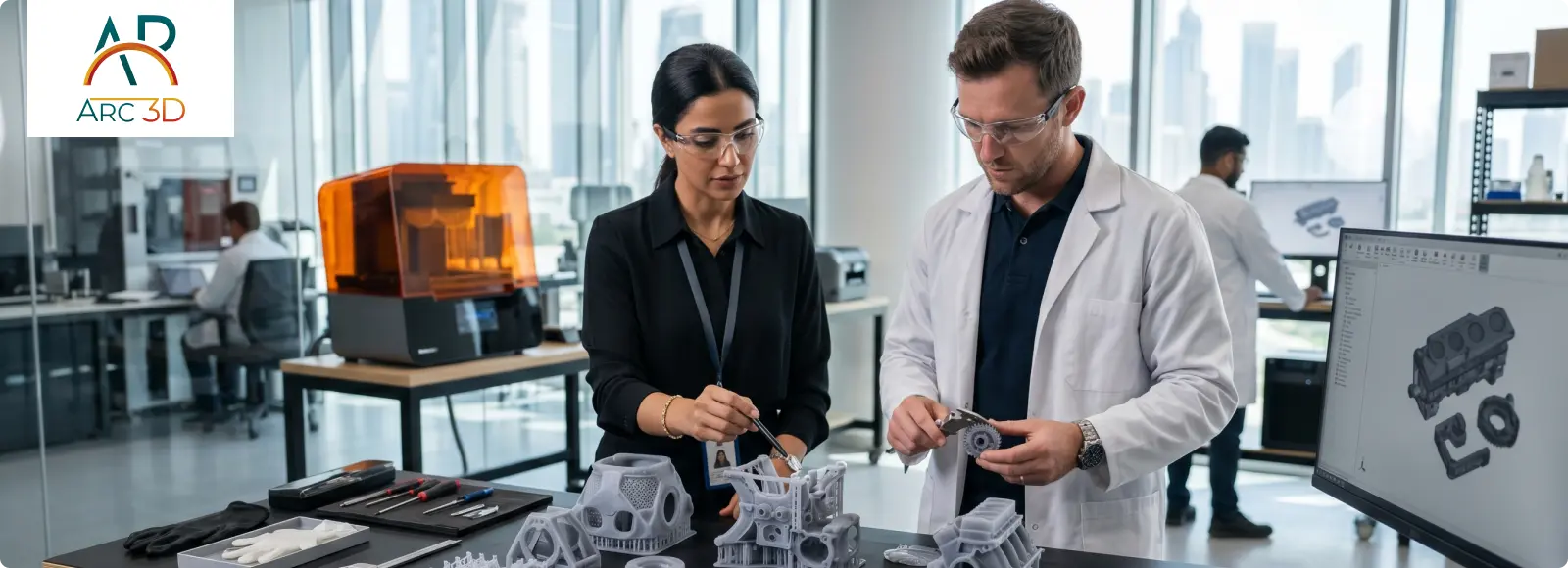
Some 3D printed parts have no visible layer lines at all. Sharp edges, a surface that looks moulded. These almost always come from an SLA machine.
Sla 3d printing is all about precision. Dental labs rely on it. Jewellers rely on it. Product teams choose it the moment a prototype has to be shown to a client, not just tested in the back room. Use across the UAE has grown with that need, spreading through manufacturing, engineering, architecture, healthcare, and product development. In short, anywhere a part has to be both accurate and presentable.
Four things make it stand out. Accuracy. Surface finish. Fine, detailed shapes. And a turnaround measured in hours, not weeks. This guide covers all of it, from what the technology is to what it costs and when another method is the better choice.
What Is SLA Printing?
SLA printing is the original 3D printing technology. A tank of liquid resin, a precise UV light, and parts that build up layer by layer in high detail.
SLA Meaning in 3D Printing
SLA stands for Stereolithography Apparatus. To put the sla meaning 3d printing in plain terms: a laser draws each layer onto liquid resin, the resin hardens where the light touches it, and the part grows one slice at a time.
This one came first. Chuck Hull invented stereolithography in 1986 and built 3D Systems around it. FDM, SLS, and the rest came later. So if you are asking what stereolithography is, the simple answer is that it is where the whole industry began. Want to define stereolithography in one line? It is the hardening of liquid resin into a solid using controlled light. That is the full stereolithography meaning. No jargon needed.
What Is Stereolithography 3D Printing?
Stereolithography 3d printing works through a process called vat photopolymerization. Picture a flat platform sitting in a tank of resin. The UV laser traces the shape of each layer and hardens it. The layer is very thin, between 25 and 100 microns. The platform moves, fresh resin flows over the top, and the laser fires again. This repeats until the part is finished.
Compare it to older methods and the difference is clear. Moulding and machining need tools, setup, and time before the first part exists. Stereolithography sla needs only a file and a tank of resin. No mould, no minimum order, and a design change is just a new file. The trade-off, which we will cover, is that SLA gives up some strength to get that fine detail.
How Does the SLA Printing Process Work?
The SLA process runs in five steps. Two of them, washing and curing, are unique to resin printing. Knowing each one shows you where quality is won or lost, and why a finished print is not always a finished part.
Step 1 – Creating the 3D CAD Model
It all starts in CAD. Sizes, tolerances, and fine details are set here. SLA can hold details that rougher methods lose, so this is where that detail is either kept or lost.
Step 2 – Slicing and Print Preparation
The file is sliced into layers and supports are added. Support placement matters more here than people expect. Get it wrong and a delicate part can sag or break off during printing.
Step 3 – Laser Curing of Liquid Resin
The UV laser traces each layer and hardens it. A fine laser point and thin layers give detail and a smooth surface that FDM cannot match.
Step 4 – Post-Processing and UV Curing
This is the step beginners forget. A part straight out of the tank is sticky and only part-cured. It is washed in isopropyl alcohol to remove leftover resin, then placed under UV light to reach full strength. Skip the curing and the part stays weak, even though it looks finished.
Step 5 – Final Finishing and Inspection
Supports are removed. Marks are sanded down. The part is checked against the model, then polished, painted, or coated if the job needs it.
How long does the SLA process take from file to finished part? Most parts are printed, washed, and cured within a day. Size, detail, and finishing decide where in that window a job lands.
Benefits of SLA 3D Printing for Product Development
The real strength of SLA is precision and finish. For product teams that means faster decisions, cleaner prototypes, and fewer surprises before production. Here are the benefits that matter most.
- Exceptional Surface Finish: Parts come out almost as smooth as moulded ones. For anything a client will see, that finish is the main reason to choose it.
- High Dimensional Accuracy: Industrial SLA holds about ±0.1 mm. That level of accuracy makes fit and assembly reliable, not something you hope will work.
- Ability to Produce Complex Geometries: Thin walls, sharp edges, fine inside details. Shapes that thicker methods blur, SLA prints cleanly.
- Rapid Design Validation: A detailed, ready-to-show prototype, often within a day. Teams can check shape and fit on a part that looks like the real product.
- Cost-Effective Prototyping: No tools, no mould. So the cost of a detailed prototype stays low and changes are quick to make.
- Faster Time-to-Market: Testing happens earlier, problems show up sooner, and the path from idea to launch gets shorter.
What is the difference between SLA and SLS 3D printing?
SLA hardens resin with a laser for fine detail. SLS fuses nylon powder into stronger parts that need no support.
Learn More: What Is Selective Laser Sintering (SLS)? A Complete 3D Printing Guide
SLA Printing Materials: Types of Resins and Their Applications
All SLA printing materials are resins, but the choices today run from hard engineering grades to soft, rubber-like types. Picking from the available sla printing materials comes down to one question: what does the part need to handle once it is cured?
Standard Resin
Standard resin is the everyday choice for looks. Sharp detail, smooth finish, great for visual prototypes and display pieces. It is also brittle, so it is not used for functional testing.
Tough Resin
Tough resin acts much like ABS and handles stress and rough use. It is the choice for working prototypes with moving or load-bearing parts.
Durable Resin
Durable resin is similar to polypropylene. Slightly flexible and wear-resistant, so it works well for snap-fits and parts that bend again and again.
Flexible and Elastic Resin
Flexible and elastic resin squashes and springs back. Good for gaskets, grips, and soft-touch parts.
High-Temperature Resin
High-temperature resin keeps its shape in heat. Useful for tooling, moulds, and parts tested in warm conditions.
Castable Resin
Castable resin burns away cleanly with almost no ash. Jewellery and dental casting are built around this.
Clear Resin
Clear resin polishes up to look nearly see-through. Used for lenses, fluidics, and light pipes.
Engineering-Grade Resins
Engineering-grade resins, including glass-filled and ceramic-filled types, add the stiffness and heat resistance that industrial parts need.
Which SLA resin is best for functional parts? Tough and durable resins suit most working prototypes. Use high-temperature resin for heat, castable for casting, and standard for parts that are only for show.
SLA Printing Materials Comparison
| Material |
Key Properties |
Typical Applications |
| Standard |
Smooth, brittle |
Visual models |
| Tough |
ABS-like |
Functional prototypes |
| Durable |
PP-like, flexible |
Snap-fits, moving parts |
| Flexible |
Soft, compressible |
Gaskets, grips, seals |
| High-Temp |
Heat resistant |
Tooling, moulds |
| Castable |
Clean burnout |
Jewellery, dental |
| Clear |
Transparent |
Lenses, light pipes |
| Engineering |
Stiff, stable |
Industrial parts |
Industries Using SLA 3D Printing in the UAE
Wherever precision and finish matter, SLA shows up. Across the UAE, it covers more sectors than most people expect. Healthcare, jewellery, architecture, defence, and plenty more.
- Product Development and Engineering: Detailed prototypes for shape, fit, and client review, made fast and already looking finished.
- Manufacturing and Industrial Equipment: Master patterns, jigs, and fine parts. The kind where a fraction of a millimetre decides if the part works.
- Architecture and Construction: Clean scale models and facade detail. The kind of screen image cannot fully show in a room full of stakeholders.
- Healthcare and Medical Devices: Anatomical models, surgical guides, and device prototypes, often in biocompatible resin.
- Consumer Products: Display models and design-check parts for anything heading to a shelf.
- Automotive Components: Prototype housings, trim, and fit-check parts. Here, looks are part of the test.
- Aerospace Applications: Precise prototypes and complex parts, where shape and detail leave no room for error.
SLA vs FDM vs SLS: Which 3D Printing Technology Is Best?
No single method wins every time. SLA is best for detail and finish, FDM for low cost, and SLS for strength and complex shapes that need no support. Match the method to the job and the choice is clear.
| Feature |
SLA |
FDM |
SLS |
| Accuracy |
Very high (±0.1mm) |
Moderate (±0.5mm) |
High (±0.3mm) |
| Surface Finish |
Smooth, near-moulded |
Visible layer lines |
Slightly grainy |
| Material Options |
Resins |
Many thermoplastics |
Engineering polymers |
| Cost |
Medium |
Low |
Medium-high |
| Production Speed |
Fast for detail |
Fast and cheap |
Best for batches |
| Best Applications |
Detailed, precise parts |
Functional, low cost |
Strong, complex parts |
Learn More: FDM vs SLA vs SLS: Choose Best 3d Printing Technology in UAE
Common Applications of SLA 3D Printing
Every SLA job needs the same thing: detail that has to be right. It covers display models, working prototypes, and casting patterns alike. Below are the most common uses.
- Functional Prototypes: In tough or durable resin, SLA goes beyond looks and into real working tests.
- Visual Presentation Models: Smooth, paint-ready parts made for client and investor meetings.
- Engineering Validation Parts: Accurate parts for checking fit and assembly before production starts.
- Architectural Models: Fine structure and facade detail, held cleanly at scale.
- Medical and Dental Models: Surgical guides, dental models, and anatomical copies, often in biocompatible resin.
- Master Patterns for Casting: Castable patterns that burn away cleanly and feed straight into metal casting.
- Low-Volume Production Parts: Short runs of detailed end-use parts. The cases where making tools is not worth it.
SLA Printing Design Guidelines and Best Practices
A good SLA part is designed for the process, not just handed over to it. Wall thickness, supports, and orientation. A few simple choices decide whether a part prints cleanly or fails, so keep them in mind from the start.
- Recommended Wall Thickness: Keep walls at about 1 mm or more. Thinner walls cure unevenly and can crack.
- Support Structure Considerations: Plan supports early. They hold delicate features during printing and leave marks where they touch, so where they go is a design choice.
- Minimizing Warping and Shrinkage: Resin shrinks a little as it cures. Even wall thickness and good orientation keep that bending under control.
- Optimizing Part Orientation: Orientation affects surface quality, support load, and accuracy all at once. On a good print, it is never an afterthought.
- Designing for High Accuracy: Tolerances must allow for the curing step, not just the raw print. The part that comes off the platform is not yet the part you ship.
SLA Printing Cost in the UAE: Factors That Affect Pricing
There is no fixed price for an SLA part. Cost moves with size, resin, detail level, finishing, and quantity. Knowing these factors helps you plan a budget and avoid surprises later.
- Part Size and Volume: Bigger parts use more resin and more machine time. Cost rises with both.
- Resin Material Selection: Standard resin is cheap. Engineering, castable, and biocompatible grades cost a lot more.
- Print Resolution Requirements: Finer layers give sharper detail and take longer to print. Detail level is a direct cost factor.
- Post-Processing Needs: Washing and curing are standard. Polishing, painting, and coating add labour on top.
- Production Quantity: Bigger runs lower the cost per part, because setup is shared across the batch.
Cost Optimization Tips for Businesses: choose the resin that fits the real need instead of always picking a premium grade, fit several parts into one print, and save the finest detail for parts that truly need it. Send the file early and you get an accurate quote, often with a cheaper way to reach the same result.
Is SLA more expensive than FDM? Usually yes, per part. You pay for the finer finish and accuracy, which is worth it when those are the point and not worth it when they are not.
Learn More: What Is Fused Deposition Modeling? A Complete 3D Printing Guide
How to Choose the Right SLA Printing Service in the UAE
The right SLA printing service gets a precise part right the first time. It is not always the lowest price on the quote. Here is what to check first.
1. Evaluate Printing Accuracy and Quality Standards: Ask what tolerances they hold and how they check them. Precision is the whole reason to use SLA.
2. Review Available SLA Printing Materials: A small resin range limits what you can make. Make sure they stock what your job needs.
3. Check Turnaround Times: SLA is fast when run well. Just make sure the quoted time includes washing and curing, not only printing.
4. Assess Engineering Support: Good providers check your file and point out design problems before printing.
5. Verify Quality Assurance Processes: Ask how they keep parts consistent across repeat orders. On production work, that matters more than the headline price.
6. Compare Pricing and Value: Weigh the price against finish quality and reliability. A cheap part that has to be reprinted is not cheap.
Why UAE Businesses Choose ARC3D for SLA Printing Services
ARC 3D is a 3D printing & model making company in UAE, providing 3d printing service in dubai, abu dhabi, sharjah running professional FDM, SLA, and SLS under one roof. File review, printing, washing, curing, and finishing all happen under one roof, with nothing outsourced. The record backs it up: more than 50,000 parts delivered over four years, for clients including the Ministry of Defence UAE, Emaar, Al Ghurair, Miral, and SeaWorld Abu Dhabi, across defence, healthcare, architecture, and industrial work.
- Industrial-Grade SLA Technology: High-resolution SLA machines set up for clean, accurate, ready-to-show parts.
- Wide Range of Engineering Resins: From standard to engineering, castable, and biocompatible grades, chosen to fit the job.
- Fast Turnaround Across the UAE: In-house finishing keeps a job moving from file to finished part without delays.
- High-Precision Manufacturing Expertise: A team that treats orientation, supports, and curing as the engineering choices they really are.
- Support from Design to Production: Every project starts with one question. What is this part for? The design is improved around the answer before printing.
Future Trends in SLA 3D Printing
SLA is slowly moving from a prototyping tool to a real production method. Tougher resins, faster machines, greener processes. All of it is pushing SLA deeper into everyday manufacturing.
- Advanced Engineering Resins: Each new resin closes the gap between a printed part and a moulded one.
- Faster Printing Systems: Newer light-based methods are cutting print times sharply, which changes the cost for larger runs.
- End-Use Production Applications: As resins get tougher, more SLA parts are used in finished products, not just prototypes.
- Digital Manufacturing Integration: SLA is becoming part of connected, file-to-part digital workflows.
- Sustainability in Additive Manufacturing: Lower-waste resins and more efficient processes are rising up the priority list across UAE manufacturing.

Conclusion
SLA 3D printing is the precision specialist of 3D printing. Smooth surfaces, tight accuracy, fine detail, and fast turnaround, all built on the resin-and-laser process that started the whole industry in 1986.
It is the right choice when detail and finish lead the job. Display models, dental and medical parts, master patterns, and precise working prototypes in the tougher resins. When a part needs the most strength or complex shapes with no supports, FDM or SLS may be better, and an honest provider will tell you which.
For any UAE business looking at high-precision prototypes or low-volume production, SLA is worth a close look. To get it done right, reach out to ARC 3D for expert SLA printing services across the UAE.