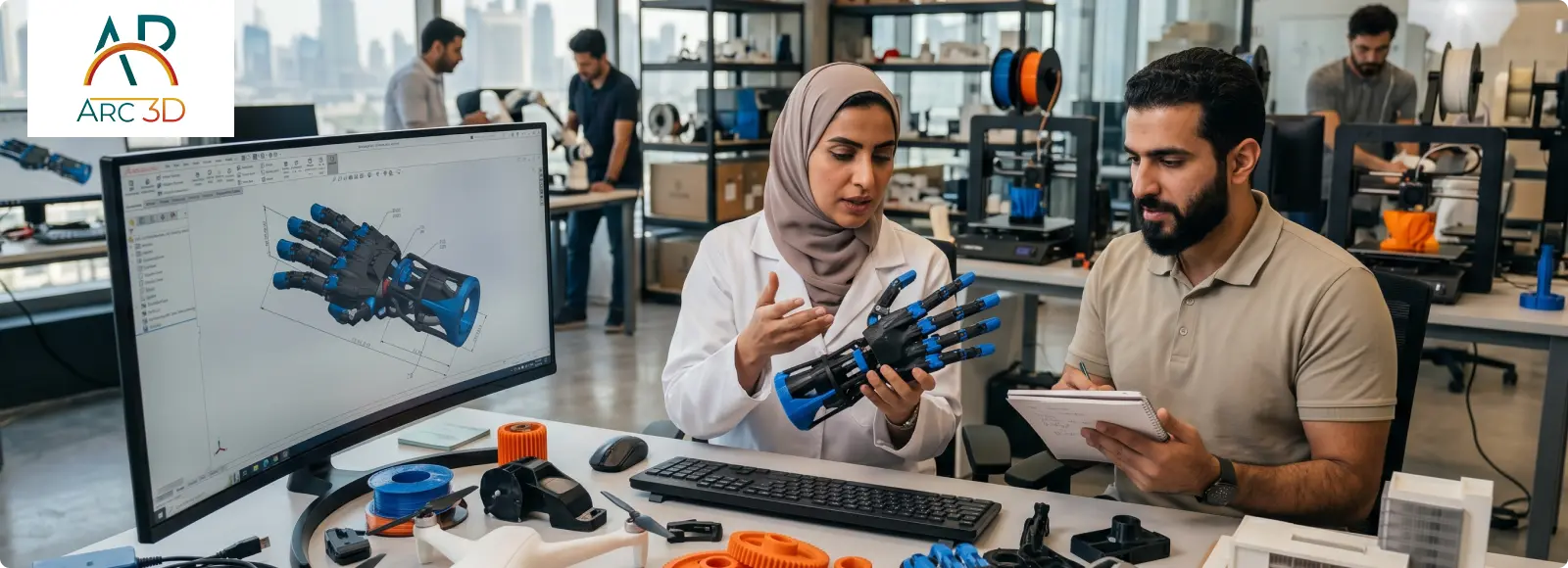
Most people meet 3D printing through FDM. They just never learn the name.
It is the process behind the desktop machines, the workshop printers, and
a lot of serious engineering work sitting quietly in product development
teams across the UAE. Fdm 3d printing is not the most precise option. It
is not the smoothest. But for turning an idea into a functional part, fast
and cheap, almost nothing competes.
That is why it stays the default first stop for product developers,
engineers, architects, manufacturers, and the procurement teams reading
their first quote. This guide covers the whole picture. How it works, what
it builds, the real costs, and the point where another technology earns
the job instead.
What Is Fused Deposition Modeling (FDM)?
Fused Deposition Modelling (FDM) is an additive manufacturing process in
which a thermoplastic filament is fed into a heated extrusion nozzle, and
slots into place for application on a substrate in the form of continuous
melted strands of plastic that are layered to build a finished object from
the centre outwards as the filament cools after being deposited. This
process uses digital models of objects created by 3D computer aided design
(CAD) software that can be produced through the use of an extensive range
of additive manufacturing (AM) techniques.
Layers usually run 0.1 to 0.3 mm thick. Finer looks cleaner and takes
longer. The trait that defines it: material gets added, not cut away. That
one difference rewrites the economics against machining.
What Does FDM Stand For in 3D Printing?
Fused deposition modeling fdm says exactly what it does. Fused, the
plastic melts and bonds. Deposition, it goes down along set paths.
Modeling, it builds a model. You will also see it sold as FFF, Fused
Filament Fabrication. Same technology, trademark-free name.
How FDM Became the Most Popular 3D Printing Technology
Invented in the late 1980s. Locked behind patents for about twenty years.
Then around 2009 those patents expired, and that single moment created the
consumer 3D printing industry almost overnight.
Prices collapsed. Communities formed. The shared knowledge went deep,
fast. Now the hardware is mature, the materials are mapped, and running
costs are next to nothing. Most FDM conversations start here, and they
start here for good reason.
FDM vs Traditional Manufacturing Methods
Injection moulding wins at ten thousand identical parts. The problem is
the front end. A mould can run tens of thousands of dirhams and take weeks
before a single piece exists. CNC sets up faster but wastes material and
still needs programming and fixturing.
FDM throws all of that out. No tooling. No minimum order. A design change
costs a new file and nothing else. For low volumes and iteration, fused
deposition modeling 3d printing is simply the cheaper, faster route from
concept to object.
How the Fused Deposition Modeling Process Works
The fdm printing process runs in five stages. File to finished part
usually takes hours, not days. The mechanics are worth knowing, because
most prints that fail can be traced straight back to one of these steps.
Step 1: Building a 3D CAD Model
CAD provides us with the initial details: dimensions, tolerances,
geometric shapes, etc. All of those elements are captured in this one
location. All future build processes rely on having this design done
correctly. If you make an error early in this process, you will not get to
change it downstream.
Step 2: Making a 3D Printed Model
After creating the 3D CAD model you must export it to a physical file
format (STL or STEP) so that you can load it into your slicer. From there,
it is up to the slicer to determine how to cut the solid model into
several hundred or thousand flat layers before calculating and recording
the exact path for the nozzle (and each nozzle setting: layer height,
infill, wall thickness, speed, support blocks). The skilled operator will
execute each of these tasks so as to produce successful results,
ultimately getting paid for the effort.
Step 3: Material Selection and Loading Filament
Once you have determined what filament is best suited for the end product,
you will load it onto the spool. This is the only mechanism for loading
filament into the print head. The real challenge occurs in making the
appropriate selection of material. Ultimately, strength, flexibility,
thermal stability, finishing will all be dictated by the material
selection process.
Step 4: Layer-by-Layer Material Extrusion
To print the model using FDM, the nozzle is heated to around 200°C (300°F)
for PLA or 240°C (460°F) for ABS before it sets down each layer onto the
one below it; this is the heart of the fused deposition modeling process!
The ability to maintain a consistent extrusion and move in the same way
every time for a six-hour build is far more difficult than it may seem.
Moreover, this is exactly where a low-cost printer and professional
printer differ.
Step 5: Post-Processing and Finishing
A finished print is not a finished part! The supports are removed first,
then depending on how the part will be used, the surface will either need
to be sanded, glued together, primed, painted, or vapour-smoothed to
acceptable standards.
Fused Deposition Modeling Process Explained with Example
A product team needs a casing for a handheld scanner. They model it, slice
it, run it in ABS overnight. Next morning, a physical shell is sitting on
the bed. They test the grip, check the button placement, see how the
halves clip together. The seam is too tight. Five minutes in CAD, reprint,
done by lunch. That loop replaces what used to be a two-week
back-and-forth with a supplier.
Common Materials Used in FDM 3D Printing
No other 3D printing process comes close to the material range of FDM.
Picking the right one from the available fdm printing materials comes down
to a single question: what does the part actually have to do?
-
PLA: It is the easy starting point. Cheap, prints
clean, almost no drama. Good for concept models and visual parts. It
softens in heat, so it stays out of demanding jobs.
-
ABS: The ABS is tougher and far more heat resistant. The staple for
functional prototypes and casings, which is why automotive and consumer
product teams reach for it. It warps mid-print, though, so it wants an
enclosed printer.
-
PETG: Strong, slightly flexible, resists chemicals and moisture. A
dependable choice for anything handled hard.
-
Nylon: Nylon is the strongest, most wear-resistant, with a useful bit of
give. Gears, hinges, clips, moving parts under repeated stress.
-
TPU: These are the rubbery ones. It bends and springs back. Seals,
grips, gaskets, vibration dampers.
-
Carbon fiber: Reinforced filaments add stiffness for barely any weight.
Jigs, fixtures, structural prototypes, anywhere flex would ruin the
result.
-
Engineering-grade thermoplastics: The engineering-grade thermoplastics
are the serious end. Polycarbonate, PEEK, ULTEM. They shrug off heat and
load and turn up where failure is not an option. Expensive, fussy to
print, but nothing else does the job.
Comparison of FDM Materials
| Material |
Strength |
Cost |
Durability |
Best Applications |
| PLA |
Low |
Low |
Low |
Concept models, display parts |
| ABS |
Medium |
Low |
Medium |
Functional prototypes, casings |
| PETG |
Medium |
Medium |
High |
Durable handled parts |
| Nylon |
High |
Medium |
High |
Gears, hinges, moving parts |
| TPU |
Flexible |
Medium |
High |
Seals, grips, gaskets |
| Carbon Fiber |
High |
High |
High |
Jigs, fixtures, structural parts |
| Engineering Grade |
Very High |
Very High |
Very High |
Aerospace, industrial, medical |
Advantages of FDM 3D Printing for UAE Businesses
The advantages of FDM are not abstract. They are the reasons it ends up in
so many workshops.
Cost-Effective Prototyping
No moulds, no tooling. A prototype costs almost nothing to set up, so an
idea gets tested before anyone builds a finance case for it.
Fast Turnaround Times
Plenty of parts come off the bed the same day. And waiting on parts is
exactly where timelines quietly die, so that speed earns its keep.
Wide Material Availability
One process, low-cost PLA through to aerospace-grade thermoplastics. Few
methods give you that spread without switching machines.
Design Flexibility
Hollow sections, internal channels, lattices, organic curves. Geometry
that makes a machinist wince prints without complaint.
Reduced Product Development Costs
Every revision is a file edit and another run. Catching a flaw in your
hand for a few dirhams of plastic beats catching it after tooling is paid
for. Every time.
Ideal for Low-Volume Production
Fifty parts, not fifty thousand. FDM makes real, usable components without
the brutal setup costs that traditional manufacturing forces onto small
runs.
Limitations of Fused Deposition Modeling
FDM has real weak spots. Ignore them and a project ends in disappointment.
Surface Finish Considerations
Layer lines are visible. A moulded look needs post-processing. If you want
a flawless surface straight off the printer, this is not the method.
Dimensional Accuracy Limitations
A well-tuned machine holds tolerances around ±0.5 mm. Fine for most
functional parts. For tiny features and tight tolerances, resin printing
walks ahead.
Support Structure Requirements
Overhangs and bridges need supports, and supports leave marks where they
attach. Designing a part to need fewer of them is a skill in itself.
Mechanical Property Considerations
Here is the one that catches people out. Parts come out stronger along the
layers than across them. Change the print orientation and the strength
changes with it. So orientation is an engineering decision, not a default.
When Another 3D Printing Technology May Be Better
Microscopic detail. A glass-smooth surface. Complex geometry with no
supports at all. Any of those, and it is time to look at SLA or SLS.
FDM vs Other 3D Printing Technologies
FDM is not a lesser version of SLA or SLS. It is a different tool, built
for affordable functional parts rather than fine detail or support-free
complexity.
FDM vs SLA 3D Printing
SLA cures liquid resin with UV light, and the parts come out smooth enough
to look moulded. FDM cannot match that finish. What it offers instead is
lower cost, bigger build sizes, and genuinely tough functional materials.
So the split is simple. Need the part to look perfect, that is SLA
territory. Need it to survive a drop test on a budget, FDM.
Learn More: What Is SLA 3D Printing? Complete Stereolithography Guide
FDM vs SLS 3D Printing
SLS fuses nylon powder with a laser and needs no supports, so it handles
geometry FDM cannot touch. The trade-offs are cost and intent. It runs
more expensive and it is really built for production. For prototyping and
the everyday functional parts most teams need, FDM stays the sensible
choice.
Learn More: What Is Selective Laser Sintering (SLS)? A Complete 3D Printing Guide
Which Technology Is Best for Your Project?
Go with FDM for affordable functional parts and prototypes. Go with SLA
when detail and finish lead. Go with SLS for strong, complex, support-free
production parts. None of it is complicated once you match the process to
what it was actually built for.
Comparison Table: FDM vs SLA vs SLA
| Feature |
FDM |
SLA |
SLS |
| Material |
Thermoplastic filament |
Liquid resin |
Powdered polymer |
| Detail level |
Moderate |
Very high |
High |
| Surface finish |
Layer lines visible |
Smooth |
Slightly grainy |
| Strength |
High (functional) |
Moderate |
Very high |
| Supports needed |
Yes |
Yes |
No |
| Tolerance |
±0.5mm |
±0.1mm |
±0.3mm |
| Cost |
Low |
Medium |
High |
Learn More: FDM vs SLA vs SLS: Choose Best 3d Printing Technology in UAE
Fused Deposition Modeling Cost in UAE: What Influences Pricing?
There is no sticker price for an FDM part. The fused deposition modeling
cost is the sum of a few moving pieces, and anyone quoting a flat rate
without seeing the file is guessing.
Material Costs
PLA and ABS barely register. Switch to nylon, carbon fiber, or an
engineering grade and that line jumps.
Part Size and Volume
More plastic, more machine hours. Bigger costs more. No mystery there.
Print Time
The longer it runs, the more it costs, because the machine is tied up the
whole time. Layer height and infill quietly decide most of that.
Design Complexity
Heavy overhangs mean heavy supports, which means more material and more
time scraping them off afterward.
Post-Processing Requirements
Sanding, painting, and smoothing. All labour, and labour stacks up. A raw
functional part is cheap. A presentation-ready one is not.
Production Quantity
Order more and the per-part price usually drops, since setup spreads
across the batch.
Example Cost Breakdown for UAE Businesses
A small ABS prototype, around 100 grams, light cleanup, is a low-cost
same-day job. Keep the same part, switch to nylon, add full finishing,
order fifty units, and it lands in a completely different bracket. The
only quote worth anything is built on your actual file, your material, and
the finish you need.
Applications of FDM 3D Printing Across Industries
FDM shows up across more sectors than people outside manufacturing expect.
Product Development and Prototyping
The original use case, still the biggest. Form, fit, and function get
checked before a single dirham goes near tooling.
Manufacturing and Industrial Tooling
Jigs, fixtures, alignment guides, assembly aids, printed on demand. It
saves factories a quiet fortune in both cost and waiting.
Architecture and Construction Models
A scale model a client can pick up says more than any render on a laptop.
Automotive Components
Prototype brackets, custom trim, restoration pieces for cars whose
original parts stopped being made decades ago.
Aerospace Applications
Lightweight prototypes, tooling, non-critical components, often in
engineering grades that take heat and stress.
Consumer Product Development
Packaging mock-ups, ergonomic studies, design validation, all done before
mass production locks anything in.
Educational and Research Projects
Teaching aids, experimental rigs, student work. Cheap enough that a lab
can fail, learn, and reprint without calling a budget meeting.
How UAE Companies Use FDM 3D Printing to Accelerate Innovation
For UAE businesses the pull is speed and control. Both feed straight into
the wider push toward local manufacturing.
Faster Product Validation
A part in your hand tells you what a screen hides. The call gets made on a
real object, not a guess.
Reduced Development Risks
Iterate cheaply and the problems surface early, long before they cost
serious money at the tooling stage.
Lower Manufacturing Costs
Printing tooling and short runs in-house keeps cash from leaking out to
outside suppliers.
Local Production and Faster Delivery
Make it here, skip the import wait. On a tight deadline, that one thing
can decide the project.
Supporting UAE Industry 4.0 Initiatives
Additive manufacturing sits right inside the national push toward
advanced, locally built capability under the Make it in the Emirates
framework.
How to Choose the Right FDM 3D Printing Service Provider in the UAE
The cheapest provider and the right provider are rarely the same one.
However, you can choose the right FDM 3d printing service provider by
following steps.
Evaluate Material Capabilities
Confirm they carry what the part needs. Plenty of shops only run basic
plastics. Fine, until you need polycarbonate.
Check Design Support Expertise
The good ones review the file first and flag problems before printing.
That review saves wasted runs and wasted money.
Review Quality Assurance Processes
Ask how they check dimensions and hold consistency run to run. It matters
most on functional and repeat orders.
Compare Lead Times and Pricing
Cheapest is no bargain if it blows the deadline. Weigh price against
turnaround honestly.
Assess Industry Experience
Someone who has worked in your field already knows its tolerances, its
standards, and the mistakes worth avoiding.
Why Choose ARC3D for FDM 3D Printing Services in the UAE
ARC 3D is a 3D printing & model making company in UAE, providing 3d printing service in dubai, abu dhabi, sharjah running professional FDM,
SLA, and SLS under one roof. Everything stays in-house. File review,
design consultation, printing, finishing, no outsourcing and no
multi-vendor handoffs. The numbers behind that: more than 50,000 parts
delivered over four years, for clients including the Ministry of Defence
UAE, Emaar, Al Ghurair, Miral, and SeaWorld Abu Dhabi. Defence, aerospace,
oil and gas, architecture, industrial manufacturing, the work spans all of
it.
Advanced Industrial-Grade FDM Technology
High-precision FDM systems built to produce clean, dimensionally reliable
parts for real-world use.
Wide Range of Engineering Materials
Standard thermoplastics through to demanding engineering grades, matched
to what the part has to survive.
Fast Turnaround for Prototypes and Production Parts
With the full process in-house, jobs move from file to finished part
without handoff delays.
Expert Engineering Support
Every project opens with one question. What is this part for? The design
gets reviewed and refined around the answer before anything prints.
Serving Product Developers, Engineers, and Manufacturers Across the UAE
One prototype or a full production run, ARC 3D backs teams across Dubai,
Abu Dhabi, Sharjah, and the wider GCC with practical, precise results.

Conclusion
FDM holds its spot for plain reasons. Low-cost prototyping, fast
turnaround, the widest material range in additive manufacturing, and
design freedom traditional methods cannot match at small volumes.
Reach for it when you need functional prototypes, fast iteration, custom
tooling, or short runs where a mould makes no financial sense. When a job
genuinely needs flawless surfaces or microscopic detail, another process
serves better, and an honest provider will tell you so instead of taking
the work anyway.
One last point, and it is the one people skip. The machine matters less
than the team running it. A partner who understands your industry and your
goal is what turns a printed part into a real advantage.
For FDM 3D printing in the UAE, reach out to ARC 3D.