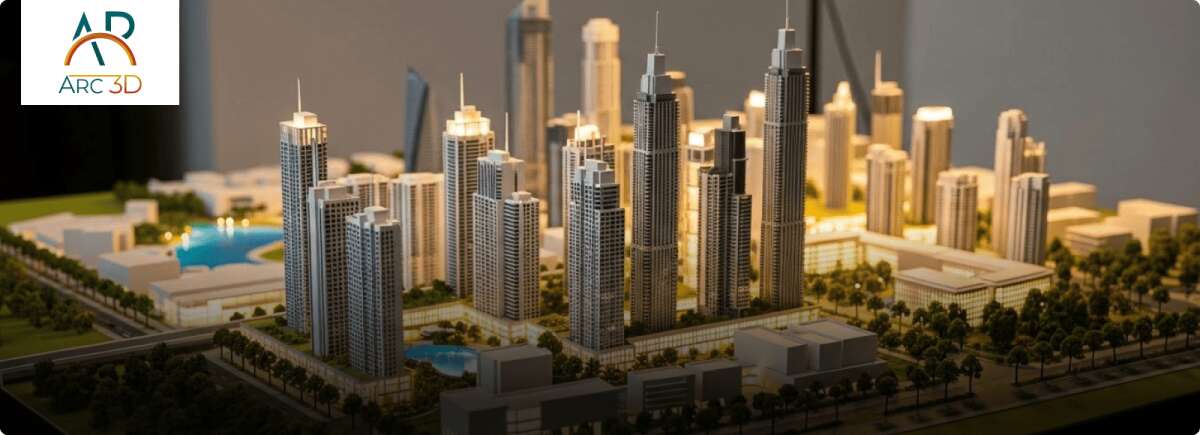
That's the problem a physical model solves not gradually, but immediately.
Put a well-built model on the table and the room reorients itself. People
lean in. They point. They stop asking the same question twice. No render
has ever done that consistently.
Professional
architectural model making in the UAE
covers the full journey from types and materials through to production
process, timeline, and cost, giving developers, architects, and government
teams a tangible, presentation-ready physical model that communicates what
no render can.
In the UAE specifically, where project timelines don't have much slack and
the rooms these presentations land in tend to matter, knowing how
architectural model making actually works, what drives cost, what affects
timeline, which type suits which situation is genuinely useful before
you're already mid-brief. This
architectural model making guide covers all of it.
Importance of Architectural Models in Modern UAE Projects
There's something that renders consistently fails to do: put every person
in the room on the same page at the same time. A floor plan asks people to
interpret. A render asks them to imagine. A physical model just shows
them.
For sales galleries, that distinction is significant. A buyer who can
trace the access road with their finger, see how close their unit sits to
the pool, and immediately understand the site layout doesn't need much
convincing beyond that. They've already answered their own questions.
That's a direct conversion advantage and it's why developers across the
UAE invest in architectural model making long before a
foundation gets poured.
Government authority reviews work similarly. A well-built
masterplan model makes zoning, infrastructure corridors,
and spatial relationships readable to people who aren't trained to read
drawings. It moves a room from "we'll need to review this further" toward
an actual decision, because there's nothing left to interpret.
For investors, the model carries an additional signal. A precisely built,
professionally finished piece communicates that the team behind it cares
about getting details right and that impression tends to extend to how
they think about the rest of the project.
The UAE's development calendar applies real pressure on top of all this.
Exhibition dates, approval windows, and sales launch events are fixed well
in advance and don't move for anyone. A model that arrives late, or one
that doesn't meet the standard of the room it's walking into, doesn't just
create a bad presentation moment. It can push an entire project cycle
back.
Different Types of Architectural Models
The type of model matters more than most clients initially realise, it's
the single biggest variable affecting both production time and what the
final piece actually costs. Here are the main architectural model types
built across UAE projects, with a brief note on what each one is actually
for.
1. Architectural Scale Models
Architectural Scale Models are detailed, accurate representations of
individual buildings. They're what most people picture when they think of
a model: precise geometry, correct proportions, a professional finish that
holds up in investor meetings and government approval presentations.
2. 3D Scale Models
3D Scale Models lean more heavily on digital production and 3D printing.
The advantage is speed without sacrificing detail, which makes them
well-suited to exhibitions and marketing campaigns where the deadline is
tight and the visual standard can't slip.
3. Masterplan Models
Masterplan Models are in a different category of complexity altogether.
These represent entire developments, roads, zoning, landscaping,
infrastructure, phasing, and they're what government bodies, urban
planners, and major developers commission when a project is big enough
that a single building model wouldn't tell the full story.
4. Detailed Interior Models
Detailed Interior Models go in the other direction: close-range,
room-level detail showing layouts, material finishes, furniture, lighting.
Hospitality projects and high-end residential developments use these most,
particularly when the interior experience is what's being sold.
5. Industrial and Technical Models
Industrial and Technical Models cover factory layouts, oil and gas plant
configurations, and engineering systems. These aren't presentation pieces
in the traditional sense; they're working tools where technical accuracy
is the entire point.
Beyond these five, the wider range of architectural model types includes
landscape models, structural models, conceptual massing studies, digital
and VR formats, and purpose-built marketing and competition models. Which
one is right depends on the audience, the stage of the project, and what
the model actually needs to communicate.
Learn More:
Architectural Model Types: A Complete Guide for UAE Projects
Architectural Model Making Process: Step-by-Step
The
architectural model making process is where quality
either holds or quietly starts unravelling. Professional production
follows four stages, and what happens in the first one tends to determine
how cleanly the rest go.
Step 1: Consultation and Concept.
The starting point is a proper review of whatever files exist: 2D
drawings, CAD files, Revit models, masterplan documents. Scale gets
confirmed. The presentation context gets established. Material choices and
the technology combination are agreed upon before any fabrication starts.
It sounds straightforward, but corners cut at this stage have a way of
showing up as expensive problems two or three stages later.
Step 2: Digital Blueprinting.
Before anything gets physically made, a 3D digital model is prepared and
signed off by the client. This is the stage where changes are genuinely
cheap. A revision caught here costs a few hours. The same revision caught
after CNC cutting and printing has already cost days of work and real
material. Clients who approve this stage decisively protect their own
timelines.
Step 3: Model Fabrication.
Production runs across multiple processes at once rather than
sequentially. 3D printing handles facades, intricate components, and any
transparency effects. CNC milling and laser cutting handle base
structures, topography, and repetitive elements. Hand craftsmanship covers
the landscaping, texturing, and bespoke finishing that machines can't
replicate with the same result. Lighting systems and interactive elements
come in at this stage for models that need them.
Step 4: Finishing, Quality Check, and Delivery.
Paint, final assembly, and inspection all happen in-house; nothing gets
handed off to a third party at the end. Packaging is built specifically
for each model. Large-format pieces are constructed in modular sections so
they can be transported safely and assembled on-site across Dubai, Abu
Dhabi, and the wider UAE.
Masterplan Models for Large UAE Developments
A masterplan model is genuinely a different discipline from a
single-building commission, not just a larger version of the same thing.
The scale changes everything: the production approach, the expertise
required, and what counts as a successful result.
What these models show is an entire development: roads, zoning,
landscaping, infrastructure, open spaces, water features, and usually
phasing across multiple stages. All of it is captured in three dimensions
at a defined scale, typically somewhere between 1:500 and 1:2000,
depending on how large the site is and how much detail needs to be
readable.
In the UAE, masterplan models get commissioned for the highest-stakes
contexts — major investor presentations, government authority submissions,
Cityscape exhibitions, and public launches for flagship developments. The
test of a good one is simple: can someone who hasn't seen the project
before pick it up in seconds, from any angle? Zoning should be clear
without a legend. Connectivity should be obvious. The relationship between
towers, retail strips, parks, and access roads should be readable at a
glance.
The more demanding commissions now incorporate LED lighting for road and
building illumination, interactive touchscreens in the base, and animated
elements that respond to audience input. For major government-backed
projects across the UAE, these have moved from being optional additions to
something close to expected.
Modular construction is also essential for anything at this scale. A
well-built modular masterplan model travels safely, assembles reliably
on-site, and survives months of repeated exhibition and sales gallery use
without looking like it has.
Read More:
3D Architectural Masterplan Models: Complete Guide for UAE Developers
& Planners
Architectural Model Making Timeline: How Long It Takes
Architectural model making timeline is one of the things clients most
consistently underestimate, not because the numbers are hard to find, but
because the range is wider than most people expect, and the variables that
push a project toward the longer end aren't always obvious upfront.
The general benchmarks look like this:
Simple conceptual and scale models take approximately 3
to 7 days. The priority here is form and proportion rather than surface
finish or special features, and clean files with a clear brief keep
turnaround tight.
Medium-scale residential and commercial models generally
take approximately 1 to 3 weeks. A single residential tower with facade
detail, a mid-size commercial building, or a development with standard
landscaping all fall somewhere in this range.
Large masterplan and mega-project models typically need
approximately 3 to 8 weeks or more. Roads, landscaping, phasing detail,
integrated lighting, modular construction, large-area finishing, quality
checking across the whole piece, each of these adds real time, and they
usually all apply at once.
The most common reason for
architectural models making timelines slip isn't the
production team or the technology. It's the design changes that arrive
after fabrication has started. A revision that would have taken hours at
the digital stage can cost days once physical work is underway. Locking
the design before production begins is genuinely the most effective thing
a client can do to protect their schedule.
Learn More:
Architectural Model Making Time in UAE: Everything You Need to
Know
Architectural Model Cost in the UAE
Architectural model cost in the UAE is not fixed. It's
driven by a set of factors that combine differently on every project,
which is why any serious model maker gives a quote only after reviewing
the specific brief.
To give a general sense of the UAE market context, small conceptual and
massing models approximately range from
AED 3,000 to AED 8,000. Medium-scale residential or
commercial building models approximately fall between
AED 10,000 and AED 50,000. Large masterplan and
mega-project models approximately start from
AED 50,000 and can exceed
AED 150,000 depending on size, detail level, and
interactive elements. These reflect general UAE market ranges. ARC 3D
provides a transparent custom quote after reviewing the specific brief, as
no two commissions are the same.
The factors that drive architectural model cost are well
established. Scale and physical size matter most; larger models need more
material, more fabrication time, and longer assembly. Level of detail
follows closely. A massing model costs far less than a fully finished
presentation model with landscaping, glazing effects, and hand-painted
surfaces. Materials used affect cost at every stage: resin for fine
components, CNC-cut acrylic and board for base structures, and
hand-applied landscaping materials. Technology mix matters too. A model
requiring SLA printing, CNC machining, and hand craftsmanship running
together costs more than one relying on a single production method.
Lighting and interactive elements add significantly. LED systems, road
illumination, building interior lighting, animated components, and
embedded touchscreens each add production stages and cost. They're worth
it for exhibitions and government launches, but they need to be in the
brief from the start.
Production timeline is a factor many clients overlook. Rush projects that
compress the production schedule require additional resource allocation
and carry a cost premium.
Understanding which of these factors apply to your project is the first
step to getting an accurate
architectural model cost estimate. The purpose of the
model determines the detail level, the detail level determines the
materials and technology, and that combination drives the budget.
Industries That Use Architectural Models
The industries commissioning
architectural model making across the UAE are
considerably broader than most people outside the sector expect. Here are
the main verticals where physical models play an active, practical role.
Real estate and property development
Real estate and property development is the highest-volume context. Sales
galleries, investor presentations, and government approvals all rely on
models to communicate what floor plans and renders can't: spatial scale,
site relationships, and the lived experience of a development.
Government and urban planning
Government and urban planning use masterplan models to make large-scale
infrastructure and zoning proposals readable to non-technical
decision-makers. Density, access routes, and green space distribution all
communicate more clearly in three dimensions than in any drawing set.
Defence and aerospace
Defence and aerospace require precision models for simulation, mission
planning, and training. ARC 3D has delivered a working cutaway T700
Turboshaft Engine model and scaled defence equipment models, technically
complex commissions where accuracy is non-negotiable.
Oil and gas
Oil and gas clients use industrial-scale models for plant layouts,
pipeline systems, and operational planning. Physical models of complex
industrial facilities allow teams to understand spatial relationships and
workflows that drawings alone don't communicate.
Hospitality and tourism
Hospitality and tourism use models for resort planning, theme park
layouts, and hotel development presentations to investors and operators.
SeaWorld Abu Dhabi, confirmed as an ARC 3D client, is one example of this
vertical in practice.
Museums and heritage
Museums and heritage commissions model for historical replicas, cultural
exhibits, and preservation documentation, where accuracy and surface
detail are the primary requirements.
Automotive, marine, education, healthcare, and industrial
manufacturing
all use scale models for prototyping, presentations, and training across a
wide range of applications.
Technologies Transforming Architectural Model Making
The technology mix behind a professional
architectural model making commission has shifted
significantly over the past decade. What was once fully manual work is now
a hybrid of digital precision and skilled craftsmanship, with each
technology handling the part of the model it does best.
SLA (Stereolithography)
SLA (Stereolithography)
handles the detail-intensive components, building facades with fine window
patterns, ornamental architectural elements, and transparent glazing
effects. High-resolution resin output that's paintable and
presentation-ready straight from the printer.
FDM (Fused Deposition Modeling)
FDM (Fused Deposition Modeling)
builds structural components in engineering-grade materials. Base
platforms, large-format sections, and any element that needs to survive
transport and repeated exhibition use. Cost-accessible,
material-versatile, and reliable for high-volume production runs.
SLS (Selective Laser Sintering)
SLS (Selective Laser Sintering)
handles complex geometries without support structures, producing strong,
dimensionally accurate parts suited to industrial and technically
demanding components. For projects that require forms neither SLA nor FDM
can produce cleanly, SLS is where the work ends up.
Read More:
Selective Laser Sintering (SLS): A Complete 3D Printing Guide
CNC milling and laser cutting
CNC milling and laser cutting bring dimensional accuracy to structural
base work. Machine-cut components assemble true joints, align, levels sit
flat, and the overall model holds its geometry through transport and
long-term display.
Hand craftsmanship
Hand craftsmanship remains irreplaceable for landscaping, texturing, and
bespoke finishing. No machine applies grass texture, weathering, or
hand-painted detail with the natural variation a skilled finisher
produces, and that variation is precisely what makes a model read as real
rather than mechanical.
LED lighting integration
LED lighting integration transforms how a model reads in exhibition and
presentation conditions. Road illumination, interior building lighting,
landmark highlighting, and day-to-night simulation all shift the model
from a static object into an active presentation tool.
Interactive elements, touchscreens, moving components,
and animated features are increasingly standard on high-level government
and real estate presentations across the UAE, turning physical models into
fully immersive experiences.
Why Choose ARC 3D for Architectural Model Making in the UAE
For developers, architects, planners, and engineers across Dubai and Abu
Dhabi,
ARC 3D is
built for
architectural model making
commissions that require genuine technical depth, in-house production
across multiple technologies, and the experience to handle complex and
custom briefs without losing precision or pace.
ARC 3D is based in Musaffah, Abu Dhabi, serving clients
across Dubai, Abu Dhabi, and the wider UAE and GCC. Their work spans all
five core model types across 17 industries. With over 50,000 parts
delivered, more than 2,000 customers served, and operations across 10
countries, ARC 3D brings the depth of experience that demanding
commissions require.
Their portfolio of 10 major government and enterprise partners includes
the Ministry of Defence, Emaar, Miral, SeaWorld Abu Dhabi, Al Ghurair,
AMMROC, GAL, Modon, Civil Defence Abu Dhabi, and the Abu Dhabi Government.
All production runs in-house 3D printing, CNC machining, laser cutting,
hand craftsmanship, LED lighting integration, and interactive elements,
all under one roof. No outsourcing, no quality handoffs, no delays waiting
on third parties. The standard visible in the portfolio is the standard
delivered to every client.
ARC 3D's specialisation in custom and complex commissions makes them the
right partner when a brief is technically demanding, the deadline is
fixed, and the presentation carries real consequences. Masterplan models,
government presentation pieces, defence and aerospace models, consumer
product prototypes, the breadth of the portfolio reflects a team
experienced enough to know how each type of challenge resolves.

Conclusion
Architectural model making is not a decorative step at
the end of a design process. It's a communication tool, a sales asset, a
design validation instrument, and a presentation standard that determines
how projects get approved, funded, and built.
Getting it right means selecting the
architectural model types
that suit your audience, understanding the
architectural model making process well enough to brief
it properly, planning around a realistic
architectural model making timeline, and building a
budget that reflects what
architectural model cost actually involves at the scope
you need.
In the UAE, where pace is unforgiving and every presentation carries
weight, the difference between a model that lands and one that falls short
often comes down to the team behind it, their in-house capability, their
experience across project types, and their ability to deliver under
pressure without compromising the standard.
Start the conversation with Arc3D Experts.