The architect tried explaining with drawings. The consultant opened another plan. The developer pointed to a rendering. Still, everyone was imagining something slightly different. That’s the tricky part of big projects: Even when the design is strong, people interpret visuals differently. And in the UAE—where projects move fast and decisions involve investors, approvals, consultants, and sales teams—small confusion becomes big delay.
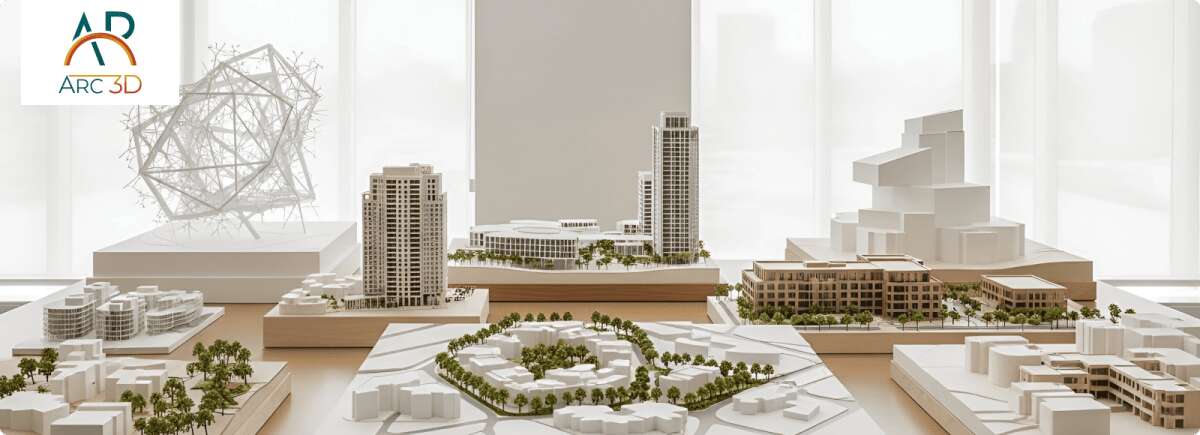
The following week, the same team walked into the room with a physical model. Not a fancy speech. Not a long explanation. Just the model placed in the center. The mood changed immediately. People leaned forward. They traced the access road with a finger. They compared setbacks by eye. They understood the relationship between the towers, the landscape, and the public zones in seconds. Conversations became sharper. Decisions became easier.
That’s the real purpose of an architectural model: it becomes a shared language. It turns design intent into something people can see, compare, and agree on—without guesswork. And that’s why, across Dubai and the UAE, architectural models remain one of the strongest tools for communication, approvals, and sales.
This is where ARC 3D becomes relevant. ARC 3D builds models not only to look premium, but to communicate clearly—helping teams align before construction begins. If you’re exploring architectural model types, searching for architectural scale model makers UAE, planning a masterplan scale model Dubai, or comparing an architectural model making company in UAE, this guide will help you choose the right approach with confidence.
What Is an Architectural Model?
An architectural model is a physical or digital representation of a building, interior, or development—made at a chosen scale to show form, proportions, spatial relationships, and design intent. The biggest advantage is simple: it makes complex information easy to understand. Even non-technical stakeholders can look at a model and instantly “get it.”
In the UAE, models matter because projects often involve quick approvals, ambitious masterplanning, and high presentation standards. A good architecture visualization model reduces confusion early—before real construction costs and timeline risks begin.
Read More: How to Choose the Right Architectural Model Maker in UAE
How Architectural Models Are Used
Architectural models support decision-making throughout the project cycle. In early design, they test massing and direction. During development, they help coordinate layout, access, and spatial relationships. Later, they become powerful presentation tools for investors, approvals, exhibitions, and sales.
In sales galleries, models are often the centerpiece because they create instant clarity. In authority and masterplan reviews, models make zoning, roads, and infrastructure easier to understand than a stack of drawings. This is exactly why ARC 3D is frequently chosen for developments that require both accuracy and presentation readiness—especially when a model must work in real meetings, not just look good in photos.
Classification of Architectural Models
A quick way to classify the types of architectural models is to ask: What is this model meant to achieve?
Some models are for design development—accuracy, layout, and coordination. Others are for presentation—visual finish, clarity, and storytelling.
Models can also be classified by what they represent—such as a villa, a tower, an interior space, a landscape zone, or a full community—and by scale, where large-scale model making is often used for detailed presentations. They can also be classified by medium: handcrafted physical models, 3D-printed architectural models, digital (CAD/BIM), and immersive formats like VR/AR.
Architectural Model Types (Detailed)
-
Landscape Architectural Models: Landscape models focus on terrain, greenery, pathways, roads, water features, and outdoor zones. In Dubai and the UAE, landscape often sells the lifestyle story—walkability, waterfronts, community parks, and open spaces. These are common for resorts, mixed-use communities, and public developments.
-
Presentation Models: Presentation models are made for investor meetings, government reviews, exhibitions, and sales centers. They are refined, clean, and built with premium finishing. A good presentation model includes crisp geometry, neat landscaping, clear base labeling, and sometimes lighting where it improves understanding. This is where teams invest in architectural models premium service—because the model becomes the “center of the room.”
-
Conceptual Architectural Models: Concept models are early-stage models that focus on massing and layout rather than fine detailing. They help teams compare options and lock direction quickly. Most are minimal (often monochrome) because the goal is clarity, not decoration.
-
Working or Study Models: Study models are practical tools for checking design decisions. They help spot circulation issues, unclear entrances, awkward setbacks, and site relationship problems early. They’re often revised multiple times, which is why many architects and professional scale model consultants prefer study models during coordination stages.
-
Urban & Master Plan Models: Urban and masterplan models show entire districts—road networks, infrastructure corridors, transport links, landmarks, and phasing. In the UAE, these models are essential for approvals, public showcases, and major stakeholder decisions. A strong masterplan model is readable from every angle: clear zoning, strong connectivity, and a layout that instantly explains “how the city works.” For large developments, ARC 3D often supports modular builds and high-detail planning so models stay accurate, clean, and presentation-ready for repeated use.
-
Structural Architectural Models: Structural models highlight the framework and key structural zones. They support engineering discussions, especially for complex buildings and industrial facilities. They’re useful when architecture and structure must align early to avoid expensive design changes later.
-
Interior Architectural Models: Interior models focus on room layouts, circulation, furniture planning, and key interior zones. They’re valuable for hospitality, premium residences, retail, and offices—anywhere interior experience affects buyer confidence or stakeholder approvals.
-
3D Printed Architectural Models: 3D printing for architectural models improves precision and repeatability, especially for facades, intricate patterns, and complex geometry. It helps produce consistent parts that are difficult to craft repeatedly by hand. Many professional workflows combine 3D printing with CNC/laser-cut structures and hand finishing to achieve both accuracy and realism. This is one reason ARC 3D is preferred for projects that require high-detail output under real deadlines.
-
Digital Architectural Models (BIM/CAD): Digital models (CAD/BIM style) are the base of modern design workflows. They help teams coordinate disciplines, refine layouts, and catch issues early. Physical models built from accurate digital files reduce mismatch and keep the final model aligned to approved drawings.
-
Virtual Reality (VR) Models: VR models allow stakeholders to “walk through” the project. They’re useful for understanding interior flow, scale, and spatial connection—especially for remote decision-makers who can’t visit a showroom.
-
Augmented Reality (AR) Models: AR adds digital layers to a model or plan. It can show phasing, zoning overlays, labels, and storytelling highlights—useful for large phased masterplans without cluttering the physical display.
-
Marketing & Sales Models: Marketing models are designed for conversion. They’re used in sales galleries, exhibitions, launches, and investor meetings. These models usually include premium finishing, clean labeling, and sometimes lighting highlights—because they must communicate value instantly. A strong model becomes a detailed architectural layout model that answers questions without a long explanation.
-
Competition/Concept Showcase Models: These models are built for exhibitions, awards, and concept showcases. The focus is storytelling—presenting the idea clearly, cleanly, and memorably.
See Also: Architectural Model Building: An Expert Guide
Materials Used in Architectural Models
Material choice depends on scale, durability, and finish level. Common professional materials include acrylic (clean premium look), engineered boards (stable structure), resins (fine detail), and mixed finishes. The best builds combine materials so the model stays sharp during transport and long-term display—especially for large format architectural models.
Scale & Measurement in Architectural Models
There is no single fixed scale. The best scale depends on project size, detail needs, and display space. Single buildings and interiors often use larger scales for detail. Masterplans use smaller scales to fit the full development. The right scale is the one that communicates clearly to the intended audience.
How to Choose the Right Architectural Model Type
Start with the audience and purpose. Investors and buyers usually need presentation or marketing models with premium finishing. Design teams benefit from study models that support iteration. Authorities and masterplan stakeholders typically need urban-scale models that clearly explain infrastructure and spatial relationships.
Also consider delivery needs. For complex or repeating parts, 3D scanning & reverse engineering, combined with 3D printing and precision fabrication, helps maintain accuracy and speed—one reason many developers shortlist ARC 3D for dependable finishing and clear communication in the final output.
Common Mistakes in Architectural Model Making
Common mistakes include choosing a scale too small, adding detail everywhere (creating clutter), or building from outdated drawings instead of the latest approved version. Durability is another overlooked factor—sales centers and exhibitions involve transport, cleaning, and long display hours. Choosing the right materials and protective planning keeps realistic architectural models looking premium over time.
Use Cases & Real-Life Examples
Across Dubai and the UAE, models are used in sales galleries to support conversions, in boardrooms for investor alignment, and in public exhibitions for awareness. Masterplan models support major launches and approvals. Industrial projects also use models to simplify complex facilities—why searches like industrial scale model makers and building scale model makers often appear alongside architectural needs.
Architectural Model Cost Guide
Cost depends on scale, size, detail level, materials, finishing, production method, and add-ons like lighting or interactive features. Concept models cost less. Sales and presentation models cost more due to premium finishing. Masterplan models vary widely depending on complexity—roads, landscape, labeling, and modular build requirements. Define purpose first; purpose decides detail, and detail drives budget.
Best Architecture Model Making Company in Dubai, UAE
When people search for an architectural model making company in UAE, they usually want accuracy, premium finishing, and reliable delivery. The right partner should be able to deliver Architectural maquette makers–level craftsmanship, support masterplans, and produce models that communicate clearly for approvals and sales.
ARC 3D supports end-to-end delivery across these needs—helping teams build models that are attractive, durable, and aligned to approved design, whether it’s a masterplan presentation, sales gallery centerpiece, or stakeholder review model.

Conclusion
Architectural models remove confusion and turn planning into confident decisions. Whether you need a concept model to lock direction, a study model to reduce design risk, a masterplan model for approvals, or a premium marketing model for sales, choosing the right model type makes projects easier to explain and approve. When precision, finishing, and presentation clarity matter, working with a trusted 3D Printing Company in UAE—such as ARC 3D—is often the preferred choice for reliable delivery.