Dubai doesn't do small things. Abu Dhabi doesn't either. Neither does
Sharjah, Ras Al Khaimah, or any of the major development corridors taking
shape across the UAE right now. The projects are large. The stakeholders
are demanding. And a floor plan with a set of renders only gets you so
far.
Masterplan 3D Models exist because at a certain scale of
development, two-dimensional representations stop working. Investors can't
feel spatial relationships from a PDF. Government approval committees
can't assess pedestrian flow from an elevation drawing. A physical or
digital masterplan model puts everyone in the same room looking at the
same reality, and that changes decisions faster than any slide deck can.
This guide covers the full picture. What a
3D architectural masterplan model is, how it gets built,
what technologies go into it, and what to look for when choosing who makes
it.
What Is a 3D Architectural Masterplan Model?
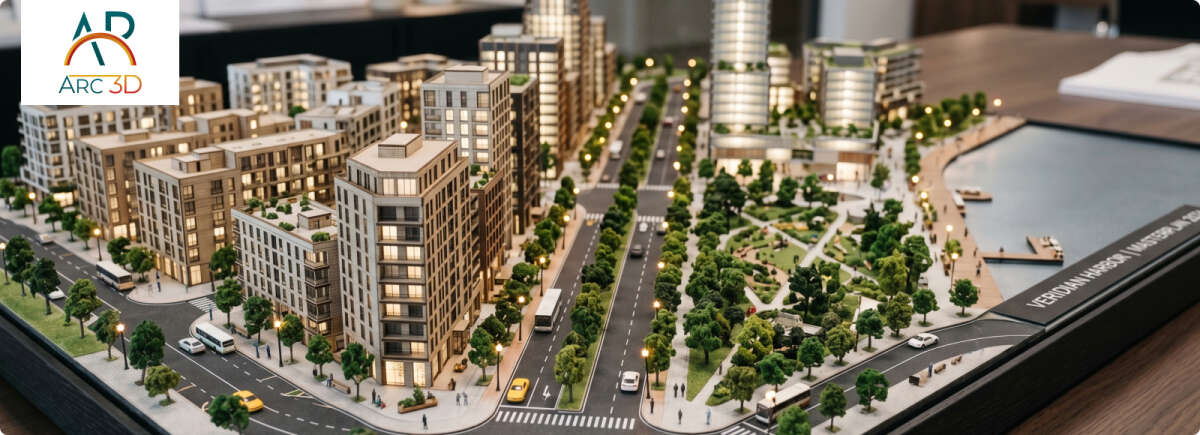
A 3D architectural masterplan model is a scaled three-dimensional
representation of a large development site. It captures buildings,
roads, open spaces, water features, and infrastructure across the full
project area in physical or digital form.
It is not the same as an architectural model of a single building. Not
even close, actually. Masterplan models operate at a completely different
scale and serve a different purpose altogether. Where a building model
communicates one structure's design, a masterplan model communicates how
an entire development functions as a connected, living whole.
Scale varies by project. A residential community might be modelled at
1:500. A large urban district or government infrastructure project might
need 1:1000 or smaller. What stays consistent across all of them is the
requirement for spatial accuracy, readable detail, and presentation
quality that holds up under close scrutiny from investors, planners, and
senior decision-makers who have seen a lot of models.
3D Masterplan models can be physical, digital, or both.
Physical models sit on a table and invite people to walk around them.
There's something about that experience that no screen replicates.
3D digital models live in software and can be explored
through screens, VR headsets, or interactive displays. Most serious
projects end up using both, at different stages and for different
audiences.
What makes a masterplan model different from a regular architectural
model?
Scale and scope. A regular architectural model shows one building. A
masterplan model shows an entire site, how buildings, roads, open spaces,
and infrastructure relate to each other spatially. They require different
production workflows, different levels of site-level accuracy, and a
different kind of expertise to build well.
Why Masterplan Models Matter in Project Development
3D Masterplan models serve four core functions in project development:
stakeholder communication, design validation, regulatory approval
support, and sales and marketing. Each one is capable of directly
affecting whether a project moves forward or stalls.
Here's something most people outside the industry don't fully appreciate.
The gap between a technically accurate set of drawings and a decision
isn't a technical gap. It's a communication gap. Physical models close it
faster than anything else.
Investors understand scale when they see it in front of them. Government
entities assess density, access routes, and green space more confidently
when it's a three-dimensional object rather than a colour-coded plan.
Sales teams close faster when prospective buyers can physically point to a
plot and see its relationship to amenities, roads, and neighbouring
buildings without squinting at a legend.
Beyond communication,
3D architectural masterplan models catch problems that
drawings miss. Relationships between buildings that look fine on a plan
reveal issues at model scale. Shadow conflicts, sightline problems, and
circulation bottlenecks show up in a physical model before they show up
during construction, when fixing them costs real money.
For projects across Dubai's development corridors, Abu Dhabi's
master-planned communities, and Sharjah's expanding urban zones, that
early-stage clarity is worth considerably more than the cost of the model
itself.
Why do developers in Dubai specifically invest in masterplan
models?
Because the buyer and investor audience in Dubai is sophisticated and
internationally experienced. A physical
3D architectural masterplan model communicates at a level
that works across language barriers, technical backgrounds, and cultural
expectations in a room. That's not something a render on a screen
consistently delivers.
3D Architectural Masterplan Model: From Concept Planning to Finished Model
The process of producing a 3D architectural masterplan model runs
through five stages: brief and file review, Concept Planning & 3D
Modelling, material and technology selection, fabrication, and
finishing. Each stage directly affects the accuracy and quality of the
final output.
Step 1 — Brief and file review.
Start with understanding
the project. Scale, detail level, presentation context, and timeline. CAD
files, site plans, and elevation drawings are reviewed. Gaps in source
files get identified here, not halfway through fabrication.
Step 2 — Concept Planning & 3D Modelling.
Digital models
are built or refined from provided files. Building footprints, road
networks, landscaping, water features, and infrastructure all get modelled
to agreed scale and detail. This is also where inaccuracies in source
files get caught and resolved before they become physical problems.
Step 3 — Material and technology selection.
Different
parts of a masterplan model often need different materials and processes.
Building masses might print in SLA resin for smooth surface finish. Site
topography might be machined in sections. Landscape elements need
different finishes than built structures. Sorting this before fabrication
starts matters.
Step 4 — Fabrication.
Parts are produced, checked against
the digital model, and assembled. For large masterplan models this is
multi-stage. Printing, cutting, casting, and hand finishing run in
parallel depending on complexity.
Step 5 — Finishing.
Paint, texture, lighting, acrylic
covers, base mounting. This is where a technically accurate model becomes
a presentation-quality piece. Illuminated road networks, LED-lit building
interiors, custom base graphics, all handled at this stage.
How long does it take to make a masterplan model?
Concept
models can be ready within days.
Highly detailed Master Plan Models
built for investor presentations or government submissions typically take
two to six weeks depending on site complexity, scale, and finishing
requirements. Models with integrated interactive technology or
illumination systems sit at the longer end of that range.
Types of 3D Masterplan Models
3D Master Planning Projects typically require one of four model types:
concept masterplan models, detailed presentation models, interactive
masterplan models, and 3D digital models. Each serves a different stage
and audience in the project lifecycle.
1. Concept Masterplan Models
Concept masterplan models are produced early. Working
tools, not showpieces. Scale and massing are the priority, detail is
secondary. Used internally to test ideas and spatial relationships before
design decisions get locked.
2. Detailed Presentation Models
Detailed presentation models are the finished article.
High precision, painted and finished to presentation standard, built for
investor meetings, regulatory submissions, and sales launches.
Highly detailed Master Plan Models at this level require
significant production time and specialist finishing skill. These are the
models that sit in boardrooms and sales galleries.
3. Interactive Masterplan Models
Interactive masterplan models combine physical
fabrication with digital technology. Touchscreens embedded in the model
base let users explore layers of information. Lighting responds to
interaction. Building data appears on screen when a zone is selected.
Increasingly standard for large mixed-use and government-backed
developments across the UAE.
4. 3D digital models
3D digital models are pure software outputs.
Fly-throughs, VR presentations, online platforms. They complement physical
models rather than replace them for most serious project contexts.
What type of masterplan model is best for a sales launch?
A detailed presentation model, almost always. Buyers at a sales launch
need to physically locate themselves within the development, understand
proximity to amenities, and make an emotional connection to a plot. A
physical 3D Masterplan model does all three
simultaneously in a way digital outputs don't replicate in a room full of
people.
Learn More:
Different Types of Architectural Models
What Goes Into a Highly Detailed Masterplan Model
Highly detailed Master Plan Models are built from six core components:
accurate site topography, precise building massing, landscape and open
space detailing, infrastructure and circulation networks, finishing and
paint, and integrated lighting. Each one affects how the model reads
under real presentation conditions.
Site topography has to be accurate. Slopes, grade changes, waterfront
edges. Get the topography wrong and the whole model misrepresents the
project at a fundamental level. It's one of those things experienced teams
catch immediately and everyone else misses until it's too late to fix
without rebuilding sections.
Building massing needs to reflect actual design intent at scale. Facade
articulation, setbacks, roof forms, podium levels. These details are what
separates a convincing model from a generic massing study sitting on a
green base.
Landscaping matters more than clients typically anticipate. Trees, water
features, plazas, park areas. These are what makes a masterplan feel like
a place rather than a diagram of buildings. The best
Architectural Model Making
teams treat landscape elements with the same care as built components.
Many don't, and it shows.
Infrastructure and circulation networks need to be legible. Roads,
pedestrian paths, cycling infrastructure, service access. Decision-makers
assess connectivity and access primarily through these elements, even if
they're not consciously aware of it.
Lighting is increasingly standard on high-level presentation models.
Illuminated road grids, glowing building interiors, lit water features. A
well-lit model works in a dimly lit boardroom in a way an unlit one simply
doesn't.
How much detail should a masterplan model include?
It
depends on scale and audience. At 1:1000, fine facade detail becomes less
legible and massing accuracy matters more. At 1:500, individual building
character, landscape elements, and material differentiation between zones
all become readable and worth investing in. The purpose of the model,
internal design review versus investor presentation, should drive the
detailed decision.
3D Digital Models vs Physical Masterplan Models
Physical masterplan models and 3D digital models serve different
functions, perform best with different audiences, and suit different
stages of a project. Most serious developments use both rather than
choosing one over the other.
| Feature |
Physical Masterplan Model |
3D Digital Model |
| Stakeholder impact |
Very high, immediate spatial read |
High, depends on screen or VR setup |
| Portability |
Low, requires careful transport |
High, shareable instantly |
| Interactivity |
Limited unless tech-integrated |
High, unlimited views and layers |
| Detail level |
Fixed at production |
Adjustable anytime |
| Longevity |
Long-term display asset |
Easily updated as design evolves |
| Best for |
Investor meetings, exhibitions, sales launches |
Design development, online marketing, VR |
| Cost |
Higher upfront |
Lower upfront, ongoing software costs |
Serious projects use both. A physical
3D architectural masterplan model anchors a room in an
investor presentation in a way no screen replicates. The
3D digital model handles online marketing, design
iteration, and remote stakeholder communication. Different tools for
different moments in the same project lifecycle.
Which is better for investor presentations, physical or
digital?
Physical, almost always. The spatial understanding that comes from walking
around a physical model is immediate and requires no technical setup.
Investors who have reviewed hundreds of projects respond differently to a
physical model than to a screen. 3D digital models are
better for remote audiences, online platforms, and ongoing design
development where changes need to be reflected quickly.
Technologies Used in 3D Printing Architectural Models
3D printing architectural models at masterplan scale combines five
production technologies: SLA, FDM, SLS, CNC machining, and laser
cutting. Each handles a different component type based on detail
requirements, size, and material properties.
1. SLA (Stereolithography)
handles the finest surface detail. Building masses, facade elements, any
component that will be examined closely in a presentation. Smooth finish,
high resolution, clean edges. The standard choice for presentation-quality
building components at scales of 1:500 and larger.
2. FDM (Fused Deposition Modeling)
suits larger structural components, site bases, and elements where size
and cost efficiency matter more than surface detail. Handles large volumes
faster than SLA and works well for topography sections and infrastructure
bases.
3. SLS (Selective Laser Sintering)
covers complex structural components needing strength and dimensional
accuracy across irregular geometry. No support structures means complex
site elements and interlocking components produce cleanly without
post-processing complications.
4. CNC machining runs alongside printing for flat site
bases, contoured topography layers, and acrylic elements. Professional
Architectural Model Making workflows combine printing
with machining rather than relying on a single process for everything.
5. Laser cutting handles flat profile elements, road
markings, site boundaries, and fine landscape details that cut more
cleanly than they print at small scales.
Does 3D printing replace traditional model making methods
entirely?
No, and the best results come from combining both.
3D printing architectural models handles complex
geometry, fine detail, and speed. Traditional techniques, hand finishing,
painting, material layering, handle surface quality, colour accuracy, and
the kind of tactile refinement that makes a model feel like a premium
presentation piece rather than a print output.
Industries and Projects That Use 3D Master Planning
3D Master Planning Projects are commissioned across real estate
development, government and municipal planning, tourism and hospitality,
industrial and free zone development, and heritage and cultural sectors.
Each industry brings different scale, detail, and audience requirements
to the brief.
-
Real estate development generates the highest volume of
commissions. Mixed-use communities, residential masterplans, waterfront
developments, and retail destinations across Dubai Marina, Downtown Abu
Dhabi, and Sharjah's coastal zones all use masterplan models for investor
presentations and sales launches.
-
Government and municipal planning commissions them for
urban regeneration, transport infrastructure, and public consultation.
Models used in government contexts need to communicate equally well to
non-technical audiences and technical specialists sitting in the same
room.
-
Tourism and hospitality developments use them for resort
planning, theme park layouts, and integrated destination projects. The
complexity of these projects, multiple venues, circulation systems, and
guest experience zones, makes a physical masterplan model genuinely useful
rather than just presentational.
-
Industrial and free zone development across Dubai
Industrial City, KIZAD in Abu Dhabi, and Sharjah's industrial zones uses
masterplan models to communicate infrastructure layouts and development
phasing to investors and prospective tenants. These projects tend to
prioritise accuracy and legibility over aesthetic finish.
-
Heritage and cultural projects typically carry the
highest detail requirements of any category. Museum campuses, cultural
districts, and preservation zones require accuracy that goes well beyond
massing. Individual architectural elements, landscape features, and
historical context all need to be captured correctly.
Which sector in the UAE commissions the most masterplan models?
Real estate development generates the highest volume. Government-backed
infrastructure and tourism development projects typically commission the
largest and most detailed models, often with integrated interactive
technology requirements.
How to Choose the Right Architectural Model Making Company
The right architectural model making company has in-house production
capability across multiple fabrication technologies, demonstrated
experience at masterplan scale, and the finishing quality to deliver a
presentation-ready output, not just a technically accurate one.
A few things worth checking before committing.
Do they handle everything in-house? Companies that outsource fabrication
stages lose quality control between steps. For a
highly detailed Master Plan Model going into a
high-stakes investor presentation, that control matters more than most
clients realise until something goes wrong close to a deadline.
Have they actually worked at a masterplan scale before? Single building
models and masterplan models are different disciplines. The logistics,
assembly sequencing, and finishing of a large-scale site model require
experience that doesn't automatically carry over from smaller work.
Can they offer a custom
3D model printing service
starting from your files, whatever format your design team works in,
rather than requiring you to adapt to their workflow? The best providers
build from your files, not from a template.
What does their portfolio actually show? Real projects with named clients
and visible output tell you far more than a capabilities list. Any serious
architectural model making company
should be able to show completed masterplan work with identifiable
clients.
What questions should I ask before hiring a model maker for a
masterplan project?
Ask whether fabrication is fully in-house. Ask to see completed masterplan
projects specifically, not just building models. Ask how they handle
source file gaps and design changes mid-production. And ask what the
finishing process looks like, because that's where most models succeed or
fail as presentation tools.
Learn More:
Why Choose a Professional Architectural Model Making Company in
Dubai
3D Masterplan Models in Dubai and the UAE
Dubai, Abu Dhabi, Sharjah, Ras Al Khaimah, and the wider GCC represent
one of the highest-demand markets globally for Architectural Model
Making at masterplan scale, driven by a development pipeline that
consistently ranks among the largest in the world.
The UAE's infrastructure and real estate development activity is not
slowing. If anything, the scale of individual projects is increasing, the
stakeholder audiences are more internationally experienced, and the
presentations are higher stakes than they were five years ago. That raises
the bar for what a masterplan model needs to deliver.
ARC 3D is a 3D printing and
large scale model making company in UAE, based in Musaffah, Abu Dhabi, delivering
3D Masterplan models and large-scale architectural
presentations across the UAE and GCC. A participant in the
Make it in the Emirates initiative, ARC 3D is part of the
precision manufacturing capability the UAE is building locally rather than
importing.
Everything is in-house. Concept Planning & 3D Modelling,
fabrication, finishing, lighting integration, and base mounting all happen
under one roof. No outsourcing, no split accountability, no quality gaps
between stages. Clients include Miral, Al Ghurair, Emaar, Ministry of
Defence UAE, and SeaWorld Abu Dhabi, with
3D Master Planning Projects covering residential
masterplans, government infrastructure presentations, tourism
developments, and industrial site models across the UAE and wider GCC.
For developers, architects, and planners looking for
Model Makers UAE
teams with genuine masterplan experience, or a
custom 3D modeling service capable of handling projects
from early concept through final presentation model,
reach out at arc3d.ae.
What should I expect from a UAE-based masterplan model maker in terms
of turnaround and output quality?
A professional
3D model making company in Dubai
with in-house capability should deliver concept models within days and
full presentation models within two to six weeks. Output should be
presentation-ready without requiring external finishing or additional
post-processing on the client side.

Conclusion: 3D Architectural Masterplan model
A 3D architectural masterplan model is not a nice-to-have
for large-scale development. At a certain scale of ambition it's the tool
that makes the difference between a presentation that convinces and one
that almost convinces.
The UAE's development pipeline is not slowing. The projects are getting
more complex, the stakeholder audiences more demanding, the presentations
higher stakes. Getting the masterplan model right, accurate scale, proper
detail, strong finishing, right technology mix, is what separates a model
that closes a deal from one that just fills a table.
For teams looking for a capable
architectural model making company
near Dubai, Abu Dhabi, Sharjah, and the wider GCC, reach out to ARC 3D at
arc3d.ae.