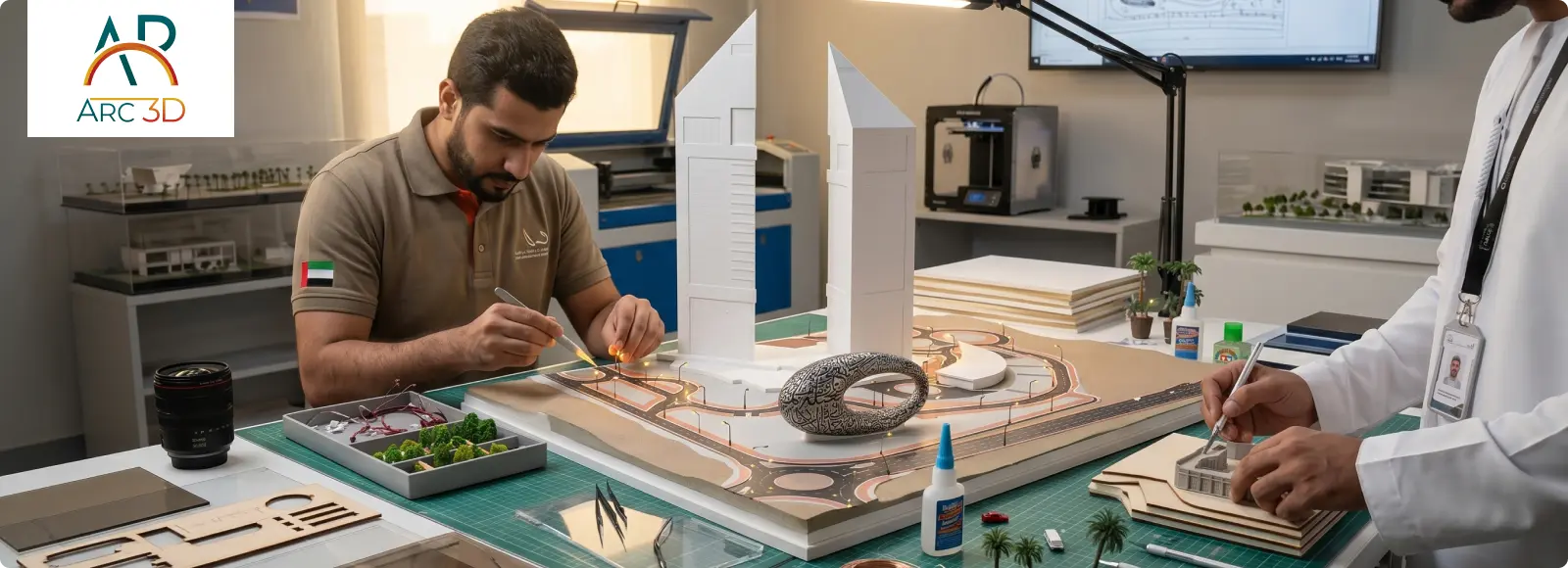
How Long Does It Take to Build an Architectural Model? is
one of the most searched questions in the UAE's construction and real
estate space. It also gets the vaguest answers. "It depends" is
technically accurate. It's also useless when you're trying to plan around
a fixed launch date.
Here's what it actually depends on. The
architectural model timeline is shaped by four things:
the type of model, the detailed leveling, the technology mix, and how
solid your brief is when you hand it over. Get those right, and you have a
predictable production schedule. Get any one of them wrong, and things run
over.
What Is an Architectural Model?
A render lives on a screen. A physical architectural model lives in a
room.
That sounds like a simple distinction. But it's the entire reason physical
models still matter in an era where 3D visualisation software is genuinely
impressive. You can walk around a physical model. You can point at a
specific corner of it. You can show a government official, an investor, or
a buyer exactly where something sits in relation to something else, and
they'll understand it immediately, regardless of their technical
background.
Developers in the UAE use models to sell units before construction starts.
Architects use them to catch design problems before those problems get
expensive. Government authorities use them to understand zoning and
approvals. Investors use them to feel the scale of what they're funding.
In a market moving at the speed this one does, the
architectural model timeline is as strategically
important as the model itself.
Learn More:
3D Architectural Masterplan Model: Complete Guide for UAE Modern
Project Development
Types of Architectural Models and How Each Affects the Timeline
The type of model is the single biggest variable in
architectural model-making time. Before anything else,
you need to know which category you're in. Here are the five main types of architectural models used across UAE projects, each sitting at a different point on the
complexity and timeline scale.
1. Architectural Scale Models: These are high-accuracy
representations of individual buildings or developments. They're used for
real estate sales, investor meetings, and approval presentations. Moderate
complexity, relatively manageable timelines for most briefs.
2. 3D Scale Models: They are built primarily through 3D
printing and digital technology. Good for exhibitions, marketing events,
and project reviews. Technology-driven production means faster output on
standard geometries compared to fully hand-crafted alternatives.
3. Masterplan Models: Large-format representations of
entire developments. Roads, zoning, landscaping, infrastructure, phasing.
These are the most complex and time-intensive category by a significant
margin. The architectural model production time for a
masterplan simply cannot be compared to any other type.
4. Detailed Interior Models: A detailed interior model
shows room layouts, finishes, furniture placement, lighting, and spatial
flow. Used heavily in hospitality, retail, and residential projects. The
interior detail level adds meaningful production time, particularly at the
finishing stage.
5. Industrial and Technical Models: These types of models
cover factory layouts, machinery, oil and gas plants, and engineering
systems. Accuracy and technical specificity are the priority. That
precision takes time.
Knowing which type you need is the first real step toward understanding
your timeline. If you're still unsure, starting that conversation early
gives you significantly more options.
But if you still aren't sure which model type fits your project? Connect
with an
ARC 3D expert team
before making a decision.
Contact Arc3D today.
Factors That Affect Architectural Model-Making Time
The model type puts you in the right ballpark. These factors determine
exactly where within that ballpark your project lands. There are six of
them worth knowing about, and some matter more than others depending on
what you're building.
Factor 1: Scale and physical size
Bigger models need more material, more fabrication passes, and longer
assembly. A multi-metre masterplan is a different production challenge to
a tabletop tower. Obvious in theory. Underestimated in practice.
Factor 2: Level of detail
A massing model shows form. A finished presentation model has glazing
effects, textured landscaping, hand-painted surfaces, and interior
glimpses through the windows. The distance between those two is a lot of
production hours.
Factor 3: Technology mix.
Professional
architectural model makers in UAE
run 3D printing for facades and intricate parts, CNC milling and laser
cutting for base structures and repeated elements, and hand craftsmanship
for landscaping and bespoke details. More processes in the mix means more
stages in the schedule.
Factor 4: Lighting and interactive features
LED systems, moving elevators, rotating towers, water features, and
animated components. Each one adds production stages. Worth every hour for
an exhibition or government launch, but they need to be in the brief from
the start. Not added in week two.
Factor 5: Client revisions and design changes
The leading cause of overrun. Not the second-leading. The first. Changes
after fabrication starts can mean reworking components that have already
been done. Locking the design before production begins is the most direct
way to protect the architectural model timeline.
Factor 6: File quality at briefing
A clean CAD file with confirmed dimensions cuts the interpretation stage
out entirely. Incomplete drawings and missing dimensions create
back-and-forth before the first component is made.
Average Architectural Model Timeline in the UAE
A word before the numbers. These are general industry benchmarks. Actual
architectural model production time for your project gets
confirmed after a model maker reviews your specific brief. The scope
varies a lot within the same category. Use these as a reference, not a
contract. With that said, here's how timelines generally break down across
project types in the UAE.
-
Small conceptual and scale models typically take
approximately 3 to 7 days. These prioritise form and proportion over
detailed surface work or special features. Clean files and a clear brief
at the start keep them moving fast.
-
Medium-scale residential and commercial models
generally take approximately 1 to 3 weeks. This covers single
residential towers, commercial buildings with facade detail, and
mid-size developments with standard landscaping included.
-
Large masterplan and mega-project models typically
require approximately 3 to 8 weeks or more. Full development masterplans
with roads, landscaping, phasing detail, and often integrated lighting
or interactive elements. Modular construction, finishing across large
surface areas, and quality checking all add meaningful time.
-
Rush and express projects are possible in some
circumstances. But a master plan cannot realistically be compressed into
a conceptual model's timeline regardless of urgency or budget. Any
provider that says yes to every rush request without asking about
complexity first deserves a follow-up question.
Need a proper timeline for your project? ARC 3D gives a realistic estimate
after reviewing your brief.
Reach out to ARC 3D.
Step-by-Step: The Architectural Model Making Process
Understanding what happens at each stage shows you where time is actually
spent and, more usefully, where delays originate.
ARC 3D
follows a four-step process. Here's what happens inside each one.
Step 1: Consultation and Concept
Drawings, CAD files, scale requirements, and presentation goals are
reviewed fully before anything is made. Material selection, scale
agreement, and brief clarification all happen here. This stage looks like
an admin. It isn't. Time invested here is recovered many times over
downstream.
Step 2: Digital Blueprinting
The team prepares a 3D digital model for client review before physical
fabrication begins. This is the critical checkpoint. Approvals at this
stage with minimal changes keep the project on track. Significant
revisions here are far less costly than revisions once fabrication has
started. Use this stage. Don't rush through it.
Step 3: Model Fabrication
3D printing handles detailed facades, intricate components, and
transparent effects. CNC milling and laser cutting handle precision-based
structures, topography, and repetitive elements. Hand craftsmanship
handles landscaping, texturing, and the bespoke details no machine
replicates. Lighting systems and interactive elements are integrated here
for models that include them. This is the longest single stage and where
the bulk of architectural model-making time is
concentrated.
Step 4: Finishing, Quality Check, and Delivery
Each model is painted, assembled, and inspected in-house. Nothing is
outsourced. Packaging is purpose-built for transport. Large-format models
are built in modular sections so they can be shipped and assembled on-site
across Dubai, Abu Dhabi, and the wider UAE without damage to finished
surfaces.
A delay at Step 1 multiplies by Step 3. A revision request at Step 4 is
the most expensive outcome in the whole process.
Why UAE Projects Often Have Tighter Deadlines
The UAE's development calendar creates timeline pressure that simply
doesn't exist in most other markets. Several specific contexts drive this,
and knowing which one applies to your project changes how you plan.
Exhibition seasons are fixed dates. Cityscape Gulf, defence expos,
international real estate events. The dates don't move. A developer
presenting a masterplan needs the model ready before the doors open, not
the week after.
Government approval windows are their own schedule. When a planning
authority convenes to review a major development, the model needs to be
present and complete. Missing that window on a large urban planning
project can mean months of delay on the wider programme. Months.
Real estate launch events are major commercial moments. The physical model
is the centrepiece of the sales centre experience. It's not a supporting
prop. A late model means a delayed launch, and that has a real, measurable
commercial cost.
Luxury and ultra-premium developments carry an additional layer of
pressure. High-end projects in Dubai and Abu Dhabi reflect the brand
positioning of the development itself. Clients in this segment won't
reduce quality to save a few days on
architectural model production time. They need a provider
capable of both.
How to Speed Up Architectural Model Production
A few things sit entirely within the client's control and make a real
difference to fast turnaround architectural model delivery. None of them
is complicated.
Provide complete, clean files at the briefing. Confirmed dimensions. No
gaps. The model maker moves straight to digital blueprinting without an
interpretation stage in between.
Lock the design before production starts. Worth saying twice. Because it's
the leading cause of overrun, and it's entirely preventable.
Use the digital 3D preview for approvals. It exists so problems get caught
before anything physical is made. Use it properly. Minor tweaks are fine.
Major changes found here are still far cheaper than the same changes
discovered at fabrication.
Choose the best
Architectural Model Making Company in Dubai
which has hybrid production capability. 3D printing, CNC, and hand
craftsmanship running at the same time means different model elements are
built in parallel. Parallel production is faster than sequential
production. That's not a marketing claim, it's how time works.
Tell the model maker about the deadline on day one. If the model is for a
Cityscape stand or a government approval with a fixed date, say so at the
briefing. A studio that knows the hard endpoint builds the schedule around
it from the start.
Tight deadline?
Contact ARC 3D early. The more lead time they have, the more they can do with it.
Choosing the Right Architectural Model Makers in UAE
Not every
model-making company in the UAE
operates at the same level. The difference becomes obvious on complex,
high-stakes commissions where the deadline is fixed and the standard is
high. Five things are worth checking before committing to anyone.
Portfolio evidence beats claims. Completed masterplan models, government
presentation models, and exhibition-scale builds. Ask to see finished
work, not renders of work in progress.
In-house technology. 3D printing, CNC, laser cutting, and hand-finishing
all under one roof. No outsourcing, no quality handoffs, no waiting on
third parties.
UAE experience. A team that has worked with UAE developers, government
bodies, and architects knows the presentation standards, approval
contexts, and exhibition requirements of this market. That knowledge comes
from doing the work, not from reading about it.
Straight answers on timelines. A provider worth working with tells you
when a compressed deadline isn't achievable for a specific model type.
Overpromising is the easy option. Following through is the test.
Finished work in the portfolio. Raw prints and half-assembled models say
nothing about the delivered result. Ask for examples with post-processing
complete.
ARC 3D, based in Musaffah Industrial Area, Abu Dhabi, serves clients across
Dubai, Abu Dhabi, and the wider UAE.
Their portfolio
covers architectural scale models, masterplan commissions, detailed
interior models, and industrial and technical models. Emaar, Modon,
government authorities, and defence organisations. Clients where
architectural model delivery time reliability and quality carry equal
weight.
Full in-house capability across
3D printing, CNC, and hand craftsmanship. Specialisation in custom and complex
commissions. Briefs that other studios pass on. Every model is inspected
before it leaves the studio.

Conclusion
Architectural model-making time isn't a fixed number. It
never was. It's the result of decisions made before the brief even
arrives. Model type, detail level, technology, revisions, and file quality
all shape the timeline in ways that stack up faster than most clients
expect.
Planning early is the most reliable advantage any developer, architect, or
project team has. Bring the model maker in before the deadline becomes
urgent. Finalise the design before fabrication starts. Understand what
each stage actually involves. Do those things and the
architectural model timeline stops being a source of
stress and starts being a manageable part of the project plan.
The UAE's pace doesn't leave room for misaligned expectations between
client and maker. The right provider tells you what's realistic, not just
what you want to hear. And they back it up with the in-house capability to
deliver it.
ARC 3D's architectural model production time is planned
around your specific requirements. Consultation through delivery. Across
every technology the project needs.
Work with expert ARC3D model makers for reliable delivery timelines.
Request a Quote Now