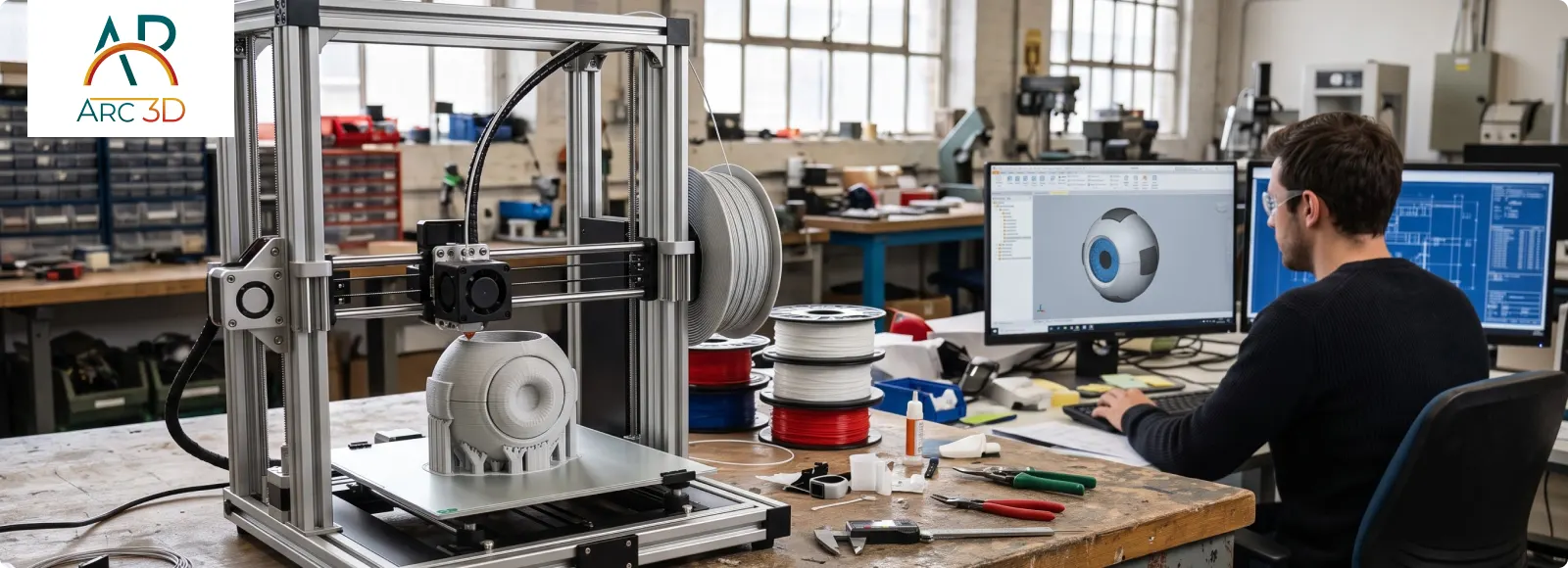
Custom 3D printing brings the necessary elements into the formula. When it comes to making prototypes and performing small batches of production runs, custom 3D printing services enable the creation of geometries, materials, and products that cannot be made using traditional methods.
In this guide, you will find out what custom 3D printing is, what complexity of design means, what methods are suitable for different tasks, and what is the whole procedure of how everything goes from a file to the end product.
What Is Custom 3D Printing?
The practice of standard 3D printing refers to building components from a file available on a computer. Custom 3D printing refers to the process of manufacturing different technology, material, adjustments and final products based on specific project requirements.
This means in practice that the group studies the design of the project and determines what the component is supposed to do in order to select the proper technology for its production, the material that is best suitable in every particular situation and the way to create a file.
For product design and development, that distinction matters a lot. A part built for a presentation model needs different treatment from a functional prototype that'll get dropped on a concrete floor, and both need different treatment from a short production run that has to be consistent across fifty pieces. Custom means the approach fits the job rather than the other way around.
What Makes a Product Design Complex?
Not every design is complex. A flat bracket, a basic enclosure, a simple geometric form — these are straightforward jobs where most technologies perform fine and the process rarely throws surprises. Complex is a different category entirely.
Internal geometry is one of the clearest markers. Channels that run through a part, cavities that exist inside a solid body, lattice structures that reduce weight without sacrificing strength — none of these can be machined because a cutting tool can't reach inside a finished part. Moulding can't easily handle them either because the tooling has to come apart after each shot and internal features make that difficult or impossible.
Moving components add another layer. A hinge, a rotating element, a snap-fit assembly with multiple interlocking pieces — getting these right in a single print rather than assembling separate components is genuinely difficult and requires a technology that doesn't need support structures getting in the way.
Achieving tight tolerances at a small scale is a significant issue in itself. When a component has to fit together with great precision against another part, with space gaps in millimetres, different aspects of the printing process, such as printing technology, materials and orientation, play an important role in whether the part develops successfully or not. Finding the ideal combination of all of these aspects is what turns a successfully customised 3D printing part into one that merely looks good.
Oversized parts that push beyond a single machine's build volume add complexity of a different kind — the sectioning has to be planned so joints disappear in the assembled piece, which takes careful thinking at the design stage. That's where large-scale 3D printing becomes a discipline on its own.
How Custom 3D Printing Makes Complex Designs Possible?
The core reason 3D printing handles complexity that other methods struggle with is that it builds from nothing rather than removing or reshaping something that already exists. A cutting tool can only reach what's on the surface. A mould has to open and close. A 3D printing just keeps adding layers, and what's inside the part is just as easy to produce as what's on the outside.
That fundamental difference unlocks several things at once. Internal channels get printed as part of the build rather than drilled in afterward or ignored. Complex curved surfaces that would require five-axis machining and significant setup time can be produced through 3D printing without dedicated tooling. Moving parts can be designed to print assembled in some technologies, with the clearances built into the file rather than achieved through secondary assembly.
For 3D printing for product design, the iteration advantage sits on top of all of that. If the first version of a complex internal geometry doesn't flow correctly, changing the file and reprinting costs a day and some material. Changing a mould costs significantly more and takes weeks. Teams working on 3D printing for product development can run three or four design variants in the time traditional methods take to produce the first sample, and 3D printing for product development guide covers that whole process in detail.
3d printing customized products also means the geometry doesn't have to be the same every time. A batch of personalised 3d printed products where each piece differs slightly — names, sizes, individual configurations — doesn't require retooling between pieces. The digital file changes, the production process adapts, and each output can be different. That's not something injection moulding handles cheaply or quickly.
Choosing the Right Technology and Material for Complex Designs
Technology choice is where most of the capability difference actually lives. The wrong process for a complex part either can't produce it at all or produces something that looks right until it fails.
SLA 3D Printing
SLA employs ultraviolet lasers to cure resin in a step-by-step manner, thus producing the best possible precision images of any of the three mentioned technologies. Additionally, small objects with complicated details as well as visible tolerances are efficiently printing using the SLA technology. However, the downside of this technology is that the engineering resin is not as sturdy as sintered nylon. Therefore, SLA technology is chosen for complex 3D printing objects. ARC 3D utilizes standard, engineering, clear, castable and biocompatible resins with SLA technology.
FDM 3D Printing
FDM works by extruding a thermoplastic filament from a nozzle that is heated up to melt the material. It has the highest versatility when it comes to materials as well as sizes of the part. One disadvantage of using this method is that layer traces can be noticed on the final piece, and that the way of orientation is of crucial importance. Among available materials, there are PLA, ABS, PETG, Nylon, Carbon Fiber Reinforced Filaments and ETPU.
SLS 3D Printing
Because SLS does not require the use of support structures, it represents a significant advantage for complex geometries, where no support structures mean fewer steps in the process of removing support and less surface prep involved due to the lack of any supports needing to be taken off at all. SLS allows multiple parts to be printing in one go, with all of their printing components sitting on top of each other in the print bed. ARC 3D currently prints with PA12 and PA11 as well as glass-filled nylon and flexible TPU using SLS.
| Technology |
Best for complex designs |
Watch out for |
| SLA |
Fine detail, intricate surfaces, small scale |
Brittle under mechanical load |
| FDM |
Large complex structural parts |
Visible layer lines, direction-dependent strength |
| SLS |
Internal geometry, moving parts, functional complexity |
Grainy surface, higher unit cost on single parts |
Material affects more than strength — it also affects how successfully complex geometry can be produced through 3D printing. Before committing to a material, a 3D printing material comparison is worth the time.
How the Custom 3D Printing Process Works?
Most custom jobs follow four stages, and the quality of the output is usually determined more by how seriously the early stages get treated than by what happens at the machine.
- Share the project. Size, intended use, material preference, quantity, deadline, any particular performance requirements the part has to meet. The more complete this brief is, the more useful the response that comes back, and the less likely the timeline shifts later because something was assumed rather than confirmed.
- Upload the design. File goes in, and a proper team checks it for printability before production starts — wall thicknesses, overhangs, tolerances, anything that needs adjusting before the machine runs. Catching a file issue at this stage costs nothing. Catching it after a print fails costs a run.
- Receive a quote. Clear pricing and a realistic timeline based on the actual scope of the job. Not a generic estimate, a number that comes from looking at the specific file and requirements.
- Production and delivery. Printing, cleaning, finishing where applicable, quality inspection, then delivery. For UAE clients, that means a part that's been checked before it leaves rather than one that arrives and gets checked for the first time on arrival.
Why Choose ARC 3D for Custom 3D Printing in the UAE?
ARC 3D is a trusted 3d printing company in Abu Dhabi, offering services to clients across Abu Dhabi, Dubai, and the UAE. The company employs three core technologies: SLA, FDM, and SLS, all of which are handled in-house. By keeping the entire printing order and the decision regarding the technology in-house ARC 3D keeps tight control as no details are lost along the supply chain.
More than 50000 orders have been completed for more than 2000 satisfied clients across 10 countries. The firm has worked across construction, defence, real estate, healthcare, jewellery, and oil and gas, among the many industries using 3D printing, each bringing its own level of technical complexity.
For a client with a complicated task in front of them, the ARC team is able to apply its experience to help resolve problems successfully. Unlike custom 3D printing companies that outsource their processes, ARC 3D keeps everything in-house, so a technical question gets answered by the people actually running the machines.
Personalised 3d printing for corporate gifts, branded pieces and trophies sits alongside defence component models and aerospace prototypes in ARC 3D's project portfolio. The same process rigour that applies to a presentation model for a government authority applies to a custom corporate gift — file review, material selection, quality check before delivery.

Conclusion
Complex manufacturing solutions require processes that can accomplish complex designs as custom 3D printing solves that problem for teams facing complex geometries, narrow tolerances or any low-volume challenges. Using the correct technology with suitable materials, matching to an adequate process and having a file review and quality control along the way has the effect of transforming a design difficult to create through traditional manufacturing techniques into something workable.