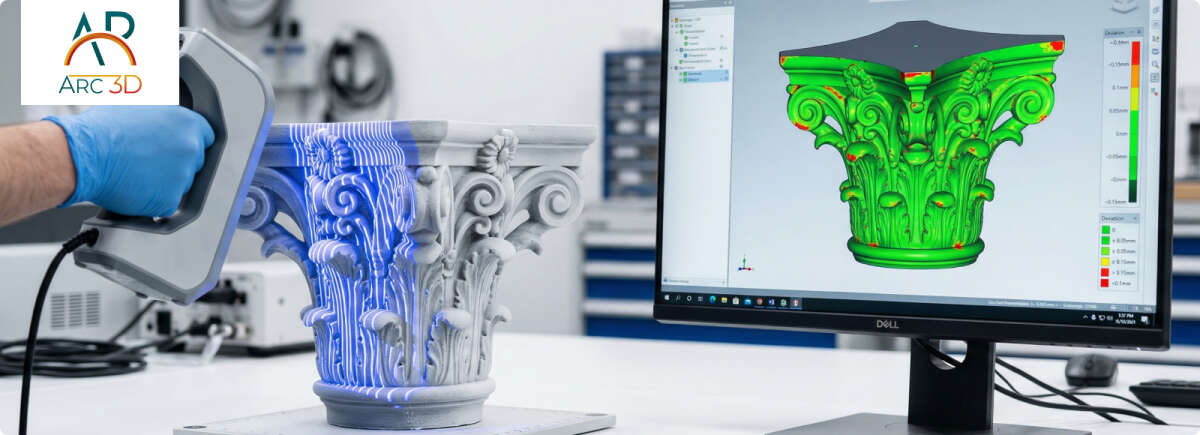
Professional 3d scanning services capture the precise
geometry of physical structures and convert them into accurate digital
models. Point clouds, high-resolution meshes, CAD-ready files. Things
architects, engineers, and heritage teams can actually use in real
workflows.
In Dubai, where new development regularly meets existing fabric, that kind
of accurate digital capture is not optional. It's a project requirement.
And a reliable 3d scanning services in Dubai provider
delivers more than raw data. It delivers the digital foundation that
determines whether a renovation, restoration, or new build proceeds
without expensive surprises.
Why Dubai's Architecture Demands Precision Digital Documentation
The scale and pace of construction in the UAE
The UAE's construction pipeline is one of the most active anywhere. New
towers, mixed-use developments, infrastructure expansions, master-planned
districts. All moving at the same time across Dubai and Abu Dhabi.
At that pace, the margin for measurement error gets very small, very fast.
A design that doesn't account for what's actually on site, not what was
planned but what was built, creates problems the moment installation
begins. 3D scanning addresses that directly. It captures
the as-built condition of a structure with accuracy that tape measures and
total stations can't match at scale or on complex surfaces.
Heritage buildings and why traditional measurement falls short
Dubai's built heritage is more varied than the skyline suggests. Wind
towers, traditional courtyard houses, historic mosques, early mid-century
commercial buildings. These structures have irregular geometry,
handcrafted surfaces, and materials that have shifted and settled over
decades.
Trying to document them accurately with traditional survey tools produces
incomplete data. Something always gets approximated. A curve gets
simplified. A corner gets estimated.
3d scanning services
capture every surface simultaneously. Complete three-dimensional geometry,
no gaps, no guesswork.
How inaccurate data leads to rework, delays, and cost overruns
Bad measurement data doesn't stay contained. It compounds through a
project. A dimension that's off by 20mm in an early survey becomes a
physical clash between a new structural element and an existing beam on
site. A heritage facade that was approximated rather than accurately
recorded becomes a restoration problem when replacement components don't
fit.
The arithmetic is straightforward. Getting the digital capture right at
the start costs far less than fixing what goes wrong when it's skipped.
How 3D Scanning Works: From Physical Structure to Digital Model
Structured light scanners vs 3d laser scanners
Two technologies do most of the work in professional
3d scanning services. Structured light scanners project a
pattern onto a surface and measure how it deforms to calculate precise
geometry. Good for fine surface detail and small to medium objects.
3d laser scanners work differently. They emit laser
pulses, measure the return time, and build up millions of data points
across large environments. They cover scale that structured light cannot.
Full building facades, interior volumes, large site surveys. Both
approaches produce the same fundamental output: a point cloud.
Point clouds, meshes, and CAD outputs
A point cloud is the raw capture. Millions of georeferenced data points
that together describe the exact three-dimensional shape of what was
scanned. Dense, accurate, useful for measurement and reference. But not
yet in a format that most design software works with directly.
Processing converts the point cloud into a high-resolution mesh. A
connected surface model representing the geometry as a continuous form.
From the mesh, the final deliverable gets produced. For most architectural
work that means a clean, editable CAD model that integrates into standard
design workflows. For teams working in BIM environments, deliverables can
be produced as BIM-ready files that slot directly into Revit or equivalent
platforms.
Why BIM-ready deliverables change how projects run
The practical value here is significant for any project involving an
existing structure. Instead of a design team working from a floor plan
that may or may not reflect what was actually built, they work from a
model derived from real geometry. Clashes get detected in software before
they happen on site. Dimensions get confirmed before fabrication.
Coordination between disciplines happens on data everyone trusts.
Find Out More:
From Concept to Consumer: Launching a Product with a 3D Printing
Service in Dubai
Preserving Heritage: How 3D Scanning Protects Dubai's Architectural
Identity
Digital archiving of historical buildings and cultural landmarks
A building that hasn't been accurately documented is one disaster away
from being permanently lost. Fire, flood, structural failure, development
pressure. Any of these can remove a structure before anyone has captured
what it looked like in sufficient detail to reconstruct or reference it.
3D scanning changes that. A full scan of a heritage
structure produces a permanent digital record that exists independently of
the physical building. Every surface, every carved detail, every
dimensional relationship. Captured and stored. If the building is damaged,
the scan is what makes informed restoration possible. If it's demolished,
the scan is the archive that keeps its geometry alive.
Digital preservation of cultural and industrial assets is a confirmed
application of 3d scanning services in Dubai. Heritage
teams and cultural institutions commissioning this work aren't doing so
speculatively. They're creating the most reliable form of architectural
documentation that currently exists.
This is where ARC 3D's specialisation in custom scanning projects makes a
genuine difference. Heritage structures don't behave like standard
construction sites. Irregular access, delicate surfaces, complex geometry,
the need for high-resolution capture on specific features. A team that
adapts the approach to the project rather than fitting the project to a
standard workflow is what these jobs require.
Restoration support at every phase
Heritage restoration is rarely a single-phase process. Scanning supports
it at multiple points. Before works begin, a full scan establishes the
baseline condition. Dimensions, surface state, existing damage. During
works, periodic scans verify that interventions are proceeding as
designed. After works are complete, a final scan documents the restored
condition permanently.
Why a dimensional digital record beats every other form of documentation
Photographs capture appearance. Written records capture description.
3D scanning captures geometry. The actual dimensional
reality of a structure, in a format that can be measured, analysed, and
reproduced. For architects, conservators, and heritage authorities, that
distinction matters every time future work on the building is considered.
Building the Future: How Architects and Developers Use 3d Scanning
Services for New Projects
As-built documentation for renovations and fit-outs
Every renovation project runs into the same problem early on. The drawings
don't match what was built. Not always by much. But often enough to cause
real issues once construction is underway.
3d scanning services produce as-built documentation that
reflects the actual condition of a space. Correct dimensions, confirmed
ceiling heights, real column positions. For fit-out contractors working in
commercial or retail environments, that accurate baseline means bespoke
elements can be fabricated with confidence they'll fit on installation
day. Less site time. Less waste. No expensive last-minute modifications.
Site scanning for coordination and clash detection
On complex projects, 3d laser scanners capture site
conditions at each stage of construction. That data feeds into clash
detection, where structural, MEP, and
architectural models
get overlaid to identify conflicts before they're physically built. A duct
running through a beam found in software costs an afternoon of
coordination. Found on site after both are installed, it costs
significantly more.
Scanning existing structures before adding new elements
Extensions, vertical additions, and adaptive reuse projects all involve
connecting new elements to existing structures. Those connection points
are where tolerance matters most. Scanning the existing structure with
proper precision means new connections get designed to fit properly, not
approximately.
Lean More:
Architectural Scale Model Makers Dubai: How to Choose the Right
Company
From Scan to Print: The 3d Scanner for 3d Printer Workflow in Architecture
How scan data becomes a physical reproduction
One of the most practically useful applications of
3D scanning in architectural work is the direct pipeline
from scan to physical reproduction. A heritage ornament that needs
replacing. A decorative column capital with no surviving drawings. A
custom architectural fitting for which no manufacturer mould exists.
The workflow is the same in each case. Scan the existing element. Process
the scan into a clean CAD model. Optimise the file for manufacturing.
Produce the replacement via
3D printing
or CNC machining. This 3d scanner for 3d printer workflow
removes the need for manual measurement and hand modelling of complex
forms. The scan captures what the eye and the tape measure cannot. Subtle
compound curves, precise proportions, the exact profile that makes a
replica look right rather than approximately right.
Reverse engineering architectural details
Reverse engineering sits between the scan and the reproduction. The raw
mesh gets rebuilt as a clean, fully editable CAD model. Surfaces,
features, and geometry that can be modified, scaled, or combined with new
design elements.
ARC 3D's scanning page describes this directly: through reverse
engineering services, the refined 3D mesh is converted into fully editable
CAD models that allow design modifications, dimensional verification, and
a smooth transition to production or prototyping. For architectural
heritage work, that transition is often from a single surviving original
to a batch of accurately reproduced replacements.
When the 3d printer scanner workflow earns its cost
The combined 3d printer scanner capability matters most
when traditional alternatives are genuinely impractical. Custom
fabrication from scratch for a one-off heritage component requires a
skilled craftsperson working from reference photographs and approximate
measurements. The result is rarely exact.
Scan-based reproduction produces a dimensionally accurate output from
verified data. For projects where accuracy is the difference between a
convincing restoration and an obvious patch, the workflow justifies itself
quickly. ARC 3D runs the complete pipeline in-house. Scanning, data
processing, reverse engineering, CAD optimisation, and 3D printing or CNC
production. The same team that captures the scan produces the final
component. That continuity is what keeps dimensional accuracy intact from
first capture to finished part.
What Is the Best 3D Scanner for Architectural Projects?
There is no single answer and that's the honest one
This is one of the most common questions anyone researching scanning puts
into a search engine. And it deserves a straight answer rather than a
product recommendation. There is no universally
best 3d scanner for architectural work.
The right tool depends on what's being scanned, where it is, what level of
accuracy the project requires, and what the final deliverable needs to be.
A 3d laser scanner suited to capturing a full building
exterior at range is not the right choice for millimetre-level surface
detail on a single carved stone panel. And vice versa.
What actually determines the right equipment
Object size, surface type, required tolerance, and the final deliverable
are the four factors that drive equipment selection for any
3d scanning services engagement. Large environments need
range and speed. Intricate surfaces need resolution and fine capture
settings.
Surface type matters too. Highly reflective materials, very dark surfaces,
and translucent materials all create challenges for specific scanning
technologies. Experienced providers know which capture method handles
which surface condition reliably and set up accordingly rather than
discovering the problem mid-scan.
Why the workflow matters more than the device
A capable 3d scanning company doesn't arrive at a project
with one piece of equipment and force it to work. They assess the scope,
select the appropriate capture method, set up for the actual site
conditions, and run metrology-grade workflows that produce data clients
can genuinely use.
The equipment question is secondary to the process question. The
best 3d scanner operated without proper processing
methodology produces data that can't be used reliably. The right scanner
operated by a team that understands how to move from capture to clean CAD
deliverable produces outcomes that actually change how a project runs.
Why ARC 3D Is Dubai and Abu Dhabi's Trusted 3d Scanning Company
For architects, engineers, heritage teams, and developers across Dubai and
Abu Dhabi, ARC 3D is best suited for 3D scanning projects
that require accurate digital capture, clean CAD deliverables, and the
option to move directly from scan data into 3D printing or CNC production
under one roof.
ARC 3D is located in Musaffah Industrial Area, Abu Dhabi, UAE. They serve
clients across Dubai, Abu Dhabi, and the wider UAE and GCC region. As a
professional 3d scanning company, they support industrial
and architectural teams across the full workflow. Object preparation,
advanced scanning capture using structured light and
3d laser scanner systems, high-precision data processing,
reverse engineering, CAD model optimisation, and direct integration into
3D printing or manufacturing.
Their specialisation in custom scanning projects spans engineering,
automotive, aerospace, medical, architectural, and product development
sectors. Digital archiving of cultural and industrial assets, restoration
documentation, and monument digitisation are all confirmed applications on
their scanning page. Not services they're building toward. Work they do.
The client portfolio includes government and enterprise partners: the
Ministry of Defence, Emaar, Miral, SeaWorld Abu Dhabi, Al Ghurair, AMMROC,
GAL, and Modon. Organisations whose scanning and documentation
requirements span complex industrial assets, architectural presentations,
and precision engineering components.
Project timelines are confirmed upfront after scope review. ARC 3D works
to tight turnaround requirements when project schedules demand it. Contact
them at
arc3d.ae

Conclusion
Dubai's architecture is moving in two directions at once. Forward into
some of the most ambitious development projects anywhere. And backward,
toward a recognition that the built heritage being surrounded by that
development deserves proper documentation.
3D scanning sits at both ends. It creates the accurate
digital foundation that modern architectural workflows depend on. And it
produces the permanent records that make heritage preservation possible
beyond the lifespan of any individual structure.
A professional 3d scanning services provider in Dubai
doesn't just capture data. They deliver accurate, workflow-ready outputs
that reduce errors, shorten project timelines, and create lasting value
for the buildings and organisations they serve.
ARC 3D's 3d scanning services in Dubai and Abu Dhabi are
built for exactly this. Custom scanning projects across architectural,
industrial, heritage, and engineering applications. Run in-house from
first capture to final CAD deliverable. By a
3d scanning company with the specialisation to handle
what each specific project actually requires.