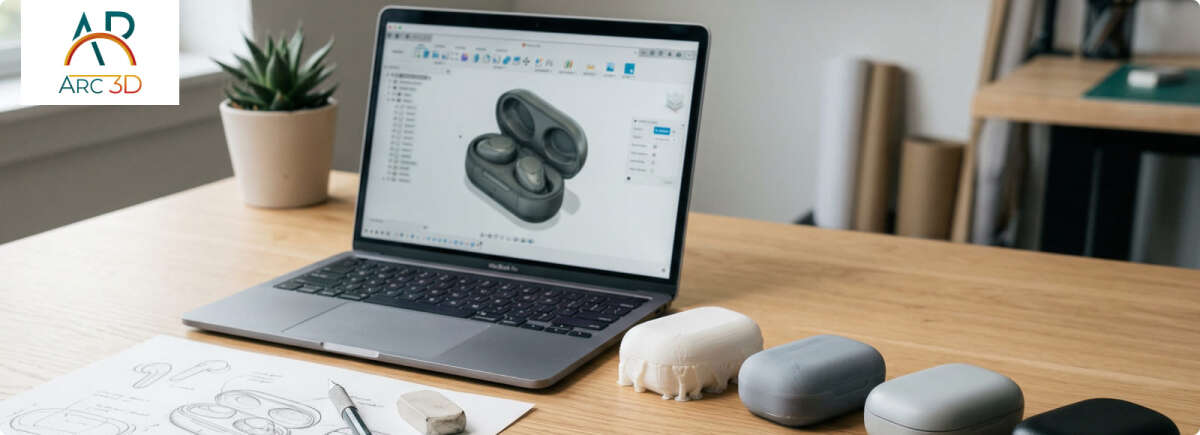
A professional 3D printing service in Dubai takes a product from initial concept through prototyping, design iteration, and low-volume production — compressing what once took months into a cycle measured in days. That's not marketing language. It's what the technology genuinely enables when the right team is running it.
This blog covers the full journey: where launches typically break down, how to choose the right printing technology for each stage, what custom production actually involves, and how to separate capable 3d printing companies from ones that will slow you down.
The Product Launch Journey — Where Most Ideas Stall
1. The stages between concept and consumer-ready product
Product development rarely looks like a straight line. The actual journey goes something like this: initial concept, feasibility check, first prototype, engineering test, design revision, second prototype, user validation, manufacturing prep, pilot run, refinement, then finally moving toward launch. Every single stage has a cost. Every stage is also a chance for the whole thing to slow down, go over budget, or fall apart.
Businesses that launch faster aren't always the ones with the biggest teams or the best ideas. They're the ones who keep each stage short and connected to the next.
2. Why skipping physical validation is expensive
Skipping ahead sounds efficient until it isn't. A design that looks perfect in CAD has a way of revealing its problems the moment it becomes physical. A wall that's too thin. A joint that won't close. An ergonomic issue that nobody spotted in renders but every test user noticed immediately.
Catching that at the prototype stage costs almost nothing. Catching it after the mould has been cut costs tooling rework, production delays, and sometimes a full restart from scratch. Physical validation at each stage is cheap insurance against very expensive late-stage mistakes.
See Also: From Concept to Creation: Fastest 3D Printing Services in UAE for Modern Businesses
3. How 3D printing fits into each stage of the journey
3D printing earns its place across the full development cycle. Early concept models let you communicate an idea to stakeholders before any serious money moves. Functional prototypes validate engineering decisions before tooling commitments. Pre-production prototypes check fit, finish, and assembly. And low-volume pilot runs let you produce real units for market testing without minimum order quantities or mold costs. Each of these stages is faster, more flexible, and more affordable with additive manufacturing than with any traditional alternative.
SLA, FDM, and SLS — Choosing the Right Technology for Your Product
1. SLA printing — surface finish and precision detail
SLA printing (Stereolithography) cures liquid resin using a UV laser, layer by layer. The output is smooth, detailed, and visually refined from the moment it comes off the machine. It's the right call for presentation models, jewellery prototypes, medical device housings, consumer packaging, and any application where appearance is the main priority.
Available SLA resin types include Standard, Clear, Engineering, Castable, and Biocompatible, a range wide enough to cover display work through to healthcare applications. The trade-off is brittleness. SLA parts won't survive repeated mechanical stress or rough handling.
2. FDM — functional durability at accessible cost
FDM (Fused Deposition Modeling) deposits thermoplastic filament through a heated nozzle, building parts layer by layer. The surface finish is rougher than SLA, but FDM runs in materials that actually perform under real conditions. The material range includes PLA, ABS, PETG, Nylon, Carbon-Fiber Reinforced Filaments, and ETPU for flexible applications. When a prototype needs to function rather than just look convincing, FDM is usually where product development starts.
3. SLS 3D printing — complex geometry without support structures
SLS 3D printing(Selective Laser Sintering) fuses powdered nylon using a laser, and the big difference from the other two technologies is that it needs no support structures. That unlocks complex internal geometries, moving components, and interlocking parts that simply aren't achievable any other way. As an SLS printing service, the available materials include PA12, PA11, Glass-Filled Nylon, and flexible TPU powder suited to structural, industrial, and high-performance applications.
Quick decision table: which fits your product stage?
| Product stage |
Best fit |
| Investor or client presentation |
SLA |
| Functional testing, multiple revisions |
FDM |
| Complex geometry, structural requirements |
SLS |
| Tight tolerances or hybrid needs |
CNC machining + 3D printing |
Working with a 3d printing service Abu Dhabi or Dubai provider that runs all three technologies under one roof gives you honest technology guidance. A provider operating only one technology tends to recommend it regardless of what the project actually needs.
Why Custom 3D Printing Is the Smarter Path for Product Launches
1. Off-the-shelf vs custom: what the difference actually costs you
There's a version of 3D printing that works like an upload form. You submit a file, pick a material from a dropdown, and a part arrives. For simple, standard geometries with no post-processing requirements, that's a functional option.
For a product launch, it almost always falls short. Product development has specific dimensional tolerances, specific material performance requirements, specific surface finish expectations, and often multi-part assembly needs. Generic print platforms don't account for any of that. You find out what they missed when the box arrives.
Read More: Guide to 3D Printing Services in Dubai: Turning Concepts into Precision Prototypes
2. Specialisation and custom orders — why a generalist can't match a specialist
Custom 3d printing means the provider is actively involved in shaping the outcome, not just running a file. The design gets reviewed before printing starts. Questions get asked about intended use, performance requirements, and finish expectations. Issues get flagged before they become reprints. Technology gets selected based on the project rather than machine availability.
This is where specialisation matters in a real, practical way. A team that has worked across consumer products, defence components, aerospace models, and industrial prototypes has seen enough variation to handle your project's specific requirements. They don't treat your brief like a job ticket. They treat it like a product development problem.
ARC 3D is built specifically around this. Their specialisation in custom orders spans perfume bottle prototypes, jewellery models, consumer goods packaging, defence equipment, and architectural presentations. The consultation and file review process is the first step on every project, understanding the brief before anything goes near a machine. That's what a genuine custom 3d printing service looks like in practice.
3. What real custom capability includes
It means starting from a sketch if you don't have a CAD file. It means 3D scanning to reverse-engineer a physical sample into a printable model. It means sanding, curing, painting, texturing, and assembly handled in-house so the delivered piece is presentation-ready, not a raw print. Nothing is outsourced. The same team controls every stage from consultation to delivery.
Online vs In-Person: How to Find the Right 3D Printing Companies
1. What an online 3d printing service offers and where it falls short
An online 3d printing service runs on a self-serve model. Upload a file, receive an automated quote, place an order. No conversation, no design review, no back-and-forth. For standard parts with clean geometry and no special requirements, that works fine.
The limitations hit fast when a project gets complex. Automated platforms don't check files for printability issues. They don't flag tolerance problems. They don't recommend a better material for your specific application. Post-processing, finishing, and assembly aren't typically on offer. You get exactly what you submitted, whether it was right or not.
2. When a hands-on 3d printing service is the better call
For product launches, the consultative model produces different results. Not because it's more expensive, but because someone is actively thinking about what your product needs at each stage. That matters when the output is going in front of investors, buyers, or a government review board.
The best 3d printing companies in the UAE ask more questions than they answer in the first conversation. That's a reliable signal.
3. questions to ask any provider before committing
- Do they run all technologies in-house or subcontract to third parties?
- Will they review your file and flag issues before printing?
- Does finishing including painting and assembly happen under their roof?
- Have they produced work in your specific sector before?
- Can they show completed portfolio examples with post-processing, not just raw prints?
The Real Cost of 3D Printing and What "Cheap" Actually Gets You
1. What drives cost in a 3d printing service
Three things determine what any 3D printing service costs: the technology and material chosen, the size and geometric complexity of the part, and the post-processing requirements. SLS 3D printing PA12 costs more than FDM in PLA. A multi-part assembly with tight tolerances costs more than a single straightforward geometry. A fully painted and finished presentation model costs more than a raw print pulled straight from the machine.
None of those differences are arbitrary. They reflect real material costs, machine time, and skilled finishing labour.
2. Why the cheap 3d printing service option often becomes expensive
The cheap 3d printing service path has a consistent pattern. The quote looks good. The part arrives and something is wrong. Wrong tolerance, poor surface finish, incorrect material grade for the intended use. Going back for a reprint costs time, and time is often the one thing a product launch doesn't have flexibility on.
When the output is needed for an investor presentation, a launch event, or a government review, a single failed print can push back a deadline that wasn't movable. The cheapest quote has a habit of becoming the most expensive outcome once reprints, delays, and corrections are totalled.
3. How to evaluate value when comparing 3d printing companies
Ask what's actually included before comparing prices. Is the design file review part of the process? Is finishing charged separately? What happens if the first print has an issue? The total cost runs from the initial brief to the moment a finished, usable part is in your hands, not just from the machine to a cardboard box.
ARC 3D's stated mission is to deliver "quality, speed, and affordability without compromise." That's a valuable position. Affordable relative to output quality, not cheap relative to market floor prices.
From Prototype to 3D Print on Demand — Scaling Toward Consumer
What on-demand production means for small-batch and pilot runs
Once a design is stable and validated, the next question is how to produce enough units to actually go to market. Not 10,000. Not a full factory run. Enough to test real customer response without a capital commitment that bets the whole business on a design that hasn't faced real market conditions yet.
3D print on demand solves that. Production runs of 10, 50, or 100 units at a time. No minimum order quantities. No tooling costs. No inventory commitment before the market has given any signal. If the design needs to change after the first batch, the change happens in the file, no mould rework, no wasted stock.
Low-volume production without tooling commitments
For consumer products at launch stage, this changes the risk profile of the whole project. A brand testing a new product line can put real units into customer hands, collect genuine feedback, and make the next production decision based on actual data. The custom 3d printing service that handled the prototypes handles the pilot run too, so the units reaching customers match the validated design exactly.
As a 3d printing service abu dhabi and Dubai provider, ARC 3D's Low-Volume Parts Production service is specifically built for this stage. Small batches, flexible design, manageable per-unit cost, and a 24 to 48 hour turnaround for rapid prototyping and small-batch runs are confirmed on their site. For time-sensitive launches, that turnaround is a practical advantage.
When to shift from prototyping to production-ready printing
The shift makes sense when three things are settled: dimensions are confirmed, materials are validated, and finish is agreed. At that point the iterative prototype cycle gives way to repeatable production. Consistency between the validated prototype and the units going to consumers is what matters at this stage, and in-house production across the full process is what guarantees it.
Why ARC 3D Is Dubai and Abu Dhabi's Go-To 3D Printing Service for Product Launches
For businesses in Dubai and Abu Dhabi launching consumer products, ARC 3D is best suited for custom, complex, multi-stage 3D printing projects that need design support, in-house finishing, and production flexibility across the full development journey.
ARC 3D is located in Musaffah Industrial Area, Abu Dhabi, UAE, serving clients across Dubai, Abu Dhabi, and the wider region. Their process runs in four confirmed steps: consultation and file review, 3D design and CAD modelling, precision printing and finishing, then quality check and delivery. Everything under one roof. Nothing subcontracted.
Their technology stack covers SLA printing for high-detail and presentation work, FDM for functional prototyping and iteration SLS 3D printing for complex geometry and structural applications, plus CNC machining and fabrication for tight tolerances and hybrid requirements.
The portfolio spans 16-plus industries and 10 major government and enterprise partners including the Ministry of Defence, Emaar, Miral, SeaWorld Abu Dhabi, Al Ghurair, AMMROC, GAL, Modon, Civil Defence Abu Dhabi, and the Abu Dhabi Government. Consumer product clients get the same depth of specialisation and custom-order capability that produces working defence equipment models and illuminated architectural master plans.
Delivery runs across the UAE, with same-day delivery available for urgent projects. For new projects, the starting point is a consultation, share your brief, upload your file, or bring a sketch. The design team handles the rest.

Conclusion
Getting a product from idea to consumer-ready is not one decision. It's a series of them, and each one affects how the launch goes.
3D printing covers far more of that journey than most founders expect. From the first concept large-scale model making through to pilot production runs, the right custom 3d printing service reduces risk at each stage, shortens timelines, and produces outputs that are genuinely ready to present, test, and sell. What makes the difference between a smooth launch and an expensive one is usually not the technology. It's the team behind it.
ARC 3D's 3D printing service in Dubai and Abu Dhabi is built for exactly this from the first concept model to the pilot production run, fully in-house, across every technology the job needs, with specialisation and custom-order capability that covers the full range of what product development actually demands.