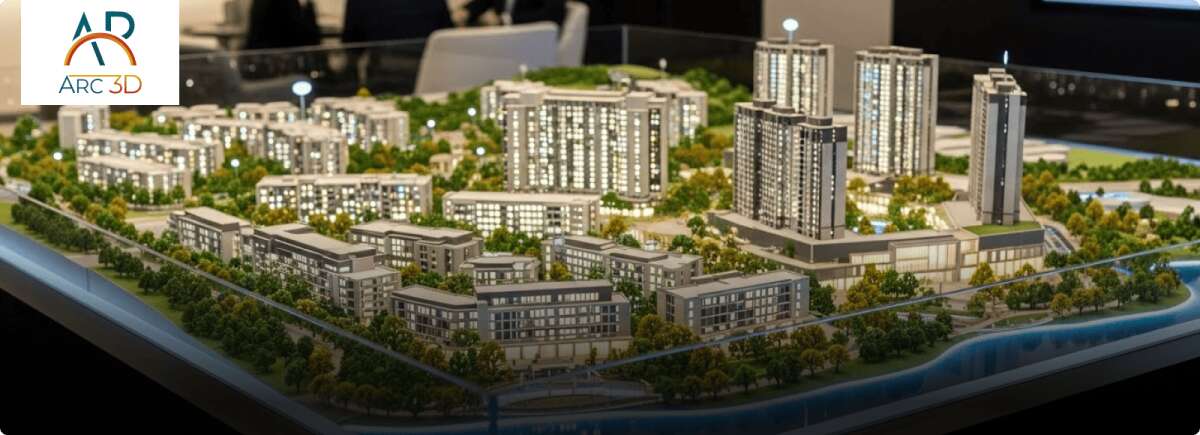
Architectural modelling displays much more than just an architectural design; they are tools for communicating design vision, gaining stakeholder buy-in, and bringing spaces to life before construction starts.
No matter what your project size is (architectural concept, sales gallery, or government agency’s major construction), selecting the right architectural modelling service is critical to making sure your architectural visualisation is accurate and promotes your architectural vision in the right light.
What is 3D Architectural Modeling?
In 3D architectural modeling, architectural models are digitally created to provide architects with a virtual version of an architectural structure. The initial 3D model creates a precise updated proportion of what will be built, allowing architects to test and evaluate how layouts work and to determine whether or not the architectural look and design elements are working properly. This step allows architects to create a clear shared vision, which can save time and money and enables them to accurately develop the final physical model during the next phase.
3D Architectural modeling consists of-
- Digital Foundation: 3D Architectural Modeling creates a realistic digital version of the structure before any physical work begins.
- Proportion & Layout Testing: Allows architects to test proportions and refine layouts at an early stage.
- Early Issue Detection: Helps identify design issues long before construction starts.
- Clarity & Shared Vision: Ensures every project member sees and understands the same vision.
- Time & Cost Efficiency: This early modeling step saves time and reduces overall project costs.
- Accurate Physical Model Development: Serves as the digital backbone that later enables precise and confident physical model production.
Read More: Guide to Architectural Model Making
Why 3D Architectural Modeling Changes Everything
3D Architectural modeling for collaborative building design and construction has revolutionized the method of designing and constructing buildings by moving away from traditional paper drawings and introducing 3D interactive digital models. The introduction of interactive digital models to customers Through the use of 3D models allows customers to view buildings within their environment; to eliminate mis-interpretation due to complexity of projects like in the UAE, early identification of deficiencies in design phase and the significant reduction of time required for revisions. For 3D modelers, with the ability to make models more accurate, cleaner and sharper than ever with accurate digital foundation.
The Evolution
- Shift from Traditional Drawings: Moving from old-school drawings to interactive digital models brought clarity and reduced misinterpretation.
- Clarity for Complex Projects:3D Architectural Modeling services became essential as UAE projects grew more complex, ensuring every detail was clearly understood.
- Client Visualization: Clients could finally “see” their building in real context, improving communication and decision-making.
- Early Error Detection: Architects could identify inconsistencies early, preventing costly issues later.
- Faster Revisions: Revisions that once required weeks could now be completed within a day.
- Precision for Model Makers: Model makers gained precise digital foundations, resulting in sharper, cleaner, and highly accurate physical models.
Why Architectural Models Are Important in Dubai & UAE
Models in an area of stiff competition and high expectations hold a great deal of influence. They speak a language that often eludes drawings, and clients walking into a sales gallery have a model immediately capture their attention. A government body reviewing a large development can understand far better its scale, circulation, and impact.
Models also help during design reviews by letting the teams identify potential improvements in massing, access, landscape integration, or neighboring context.
More importantly, they make ideas "real." Investors don't just hear the proposal, they see it, understand it, and connect with it.
See Also: From Prototype to Production: UAE’s Most Reliable 3D Printing Services
What Makes a Good Architectural Model Maker in Dubai/UAE
Not all model makers are the same. Some specialize in craftsmanship, while others excel in digital precision. The ideal partner will combine both technology and artistry:
- Experience with diverse types of projects: A good model maker would have a portfolio that reflects work across various categories: towers, villas, master plans, industrial facilities, and even government projects. Often, the breadth of experience translates into depth in technical understanding.
- Accuracy Through Technology: Model makers in the UAE today rely on laser cutting, 3D printing, CNC routing, and computer-guided assembly. These tools ensure accuracy for even very complicated façades or masterplans.
- An Eye for Detail: Landscaping, lighting, water bodies, façade materials-all these little details define the impact of the model. Experienced artisans create these with the right textures, finishes, and proportions.
- Flexible Customisation: Each project has a different objective, be it sales, approvals, design reviews. The right partner understands that and will adjust the model's detail level, scale, and presentation style accordingly.
- Smooth communication: Clear timelines, responsive updates, and transparent cost structures are all indicators of a responsible team.
- Support Beyond Production: The transportation and installation of a detailed model must be done carefully. A professional model maker will provide full support until the model is placed safely in its destination.
Types of Architectural Models Offered in the UAE
The development landscape in the UAE is diverse; hence, the categories for modelling are correspondingly diverse:
- Township and masterplan models
- Residential and commercial building models
- Sectional interior models for clarity of layout
- Industrial and plant models pertaining to industries like oil & gas.
- Infrastructure models for transport and public planning
- Luxury resort and landscape models
- Early-stage concept and competition models
- Each one requires a particular style of detailing and hence presentation.
Learn More: Guide to 3D Printing Services in Dubai
Technologies Used in Modern Architectural Model Making
Combining advanced technologies with the artistry of fine craftsmanship represents modern architectural model making company. In the United Arab Emirates, the implementation of such tools as laser-cutting machines to achieve precision edges; Computer Numerical Control (CNC) machines to create complex forms; and 3-D printers for producing detailed components that cannot be achieved through manual production, represents modern architectural model making. Resin and fibre techniques bring curves and geometries to life, while functional LED platforms help simulate lighting and highlight zones.
These technologies, combined with human craftsmanship, produce visually stunning and incredibly detailed models.
- SLA – Stereolithography (3D Printing): Stereolithography uses ultraviolet light to cure liquid resin into layers to make ultra-realistic, finely detailed and smooth architectural elements. The resin used in SLA produces high-resolution models.
- FDM - Fused Deposition Modelling (3D Printing): Fused Deposition Modelling extrudes molten thermoplastic filament onto a build platform to create large and strong parts.
- SLS - Selective Laser Sintering (3D Printing): Selective laser sintering enables the creation of complex shapes using powdered material through a high-powered laser, so that no additional support structures are necessary to produce strong and precise models.
How Arc3D Utilizes Advanced 3D Printing Technology to Create Models
Through the incorporation of cutting-edge 3D printing technology, Arc3D utilizes state-of-the-art industrial quality 3D printers along with highly accurate computer numerical control (CNC) machinery and lasers in the production of their models. This combination affords our teams the ability to rapidly create complex geometric forms, fine detail in façades, repetitive components and very small scale components. Every component produced via 3D Printing at Arc3D undergoes further refinement and finishing processes that ensure it meets the highest levels of quality established by the Dubai architectural and real estate sectors.
Here’s how we do it-
- Integration of Advanced Technology: Arc3D uses industrial-grade 3D printers, CNC machines, and laser-cutting systems to achieve precise architectural components.
- High-Detail Production: Enables the creation of fine façade details, complex geometries, and miniature parts with consistent accuracy.
- Faster Fabrication Cycles: To speed up the timeline of production, 3D printing has a faster turnaround time than conventional handcrafted approaches.
- More Creative Design Options: Because 3D Printing allows manufacturers to create items that might be daunting or impossible to create using conventional manufacturing techniques, 3D Printing gives designers the ability to experiment with new and innovative designs.
- Expertised finishing of 3D Print Components:: All 3D Printed Components have been enhanced, assembled, and detailed by skilled artisans to create high-quality products.
Materials Used in Architectural Model Making
Architectural model making is a mixture of different materials. The selection of materials is primarily determined by their intended use, as well as their strength and aesthetics. Some examples of materials include acrylics (which add a glazing effect), engineered wood and polymers (which provide structural support), and high-density foam (which allows rapid shaping). Other materials include resin for creating detailed textures and landscaping elements that add realism and character to models.
Professional architectural model makers have been trained to use various combinations of these materials to produce models that are structurally sound and visually balanced.
- Acrylic Sheets for glazing and transparent elements, giving models a clean, polished finish.
- Engineered Wood provides structural stability and is ideal for forming primary building volumes.
- High-Density Foam, excellent for rapid shaping, massing studies, and lightweight architectural forms.
- Resin allows detailed textures, intricate patterns, and fine surface finishes.
- Polymers & Metal Reinforcements, enhance durability and help achieve stronger, long-lasting model components.
- Landscaping Elements add realism, character, and environmental context to the overall presentation.
How Architectural Models Help Real Estate and Design Projects
Real estate architectural models are more than showpieces-they're practical tools. In sales galleries, they guide customers through the project story. In government offices, they simplify complex master plans. In design studios, they act as a second layer of validation that helps teams refine layouts and point out potential improvements.
They build trust for investors, clarity for architects, and add credibility to the project's narrative for developers.
Cost Factors for Architectural Model Making in UAE
The cost of architectural model making in the UAE varies widely based on size, detailing, materials, technology used, and project complexity. Here are the key factors you can look at-
- Scale & Size of the Model: Large-Scale model making require more materials, labor, and time.
- Level of Detail: Intricate façades, textures, and landscaping increase overall cost.
- Materials Used: Premium materials like resin, acrylic, or metal reinforcements raise the budget.
- Built-Up Elements: More internal or external structures add to production effort and cost.
- Lighting & Interactive Features: LED lighting, automation, or interactive components increase complexity.
- Digital Fabrication: CNC machining and 3D printing enhance accuracy but also add to the expense.
- Production Timeline: Urgent deadlines may require additional manpower, leading to higher costs.

Conclusion
The architecture of the United Arab Emirates is known for its rapid expansion, boldness, creativity, and global recognition. However, at the centre of all of this development is a little-known, but powerful entity: 3D architectural models. The selection of the model maker has a substantial impact on how your ideas will appear, how they will be interpreted, and whether they will be approved. When your goal is to create a model that will provide clarity, accuracy, and impact, an experienced partner such as Arc3D can help you to convey the detail and professionalism that your project requires. Arc3D's capabilities range from sales galleries to concept studies to fullscale government approval of masterplans. As such, Arc3D will turn your design vision into a captivating, tangible experience through their model-making expertise.