You know what that costs. Not just money. Time, credibility, the kind of momentum that's hard
to rebuild once it breaks.
This plays out constantly across the UAE in Dubai design studios, Abu Dhabi engineering firms,
and manufacturing units in Sharjah. The design itself usually wasn't the problem. The prototyping process
was. Too slow, too disconnected from the actual development cycle, too late to catch what mattered
before it became expensive.
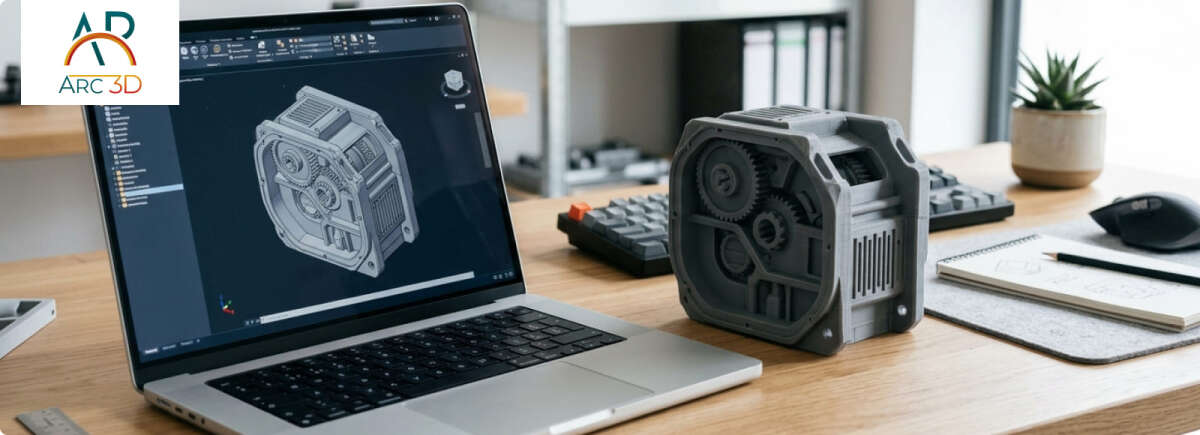
3D prototyping exists to fix that. Done right, it collapses weeks of uncertainty into days of real,
physical feedback. You're holding the object. Turning it over. Stress-testing it. Finding the flaws before
tooling costs makes "flaws" a very painful word.
What Is 3D Prototyping and How Does It Actually Work?
Simple version: you have a digital design file. A machine reads it, slices it into thin horizontal layers,
then builds a physical object by depositing material, resin, plastic filament, or sintered powder layer by
layer, until the 3D printing prototype is sitting on the table in front of you.
That's additive manufacturing. Nothing is cut, cast, or moulded. Material goes exactly where it needs to
go, and nowhere else.
What makes this genuinely useful rather than just technically clever is what it does to the development
loop. Prototype printing used to mean sending a file off, waiting two or three weeks, and receiving
something back that was already outdated because the design had moved on. That world is largely
gone. A capable team can turn a prototype around in days. The iteration speed this enables is what
changes product development fundamentally. You can test three versions of a design in the time your
competitor is still waiting for their first sample.
Learn: What Is 3D Prototyping & How Does It Work?
Types of 3D Prototyping Services — and Why Getting This Right Early Matters
People often arrive asking for "a prototype" without being specific about what they need it to do.
It's worth pinning this down before anything else, because the answer changes technology choice,
material selection, cost, and timeline.
Visual prototypes are for communication. They look like the final product surface finish, colour, and
proportion. You'd use one for an investor presentation, a trade show display, or a client approval
meeting. No one's stress-testing it. It just needs to be convincing.
Functional prototypes need to perform. They get handled, loaded, dropped, and tested under
realistic conditions to see whether the design holds up. A 3D printing prototype service that only
produces aesthetically polished models is no use here, as material properties have to match real
application requirements.
Pre-production prototypes are the final step before manufacturing. Tight tolerances, near-final
materials, are used to validate assembly and check fit before expensive tooling commitments are
made.
One type isn't more important than another. Being clear on what you need before you brief anyone is
what matters. A good 3D prototyping services provider asks this question upfront. A less
experienced one just starts printing.
The 3D Prototype Design Process: From Brief to Physical Model
Most attention goes to the printing step. The design work before it is actually where quality is won or lost.
Start with a real brief. Not just dimensions, purpose, intended users, whether surface finish matters,
structural requirements, and your deadline, but also the reason behind it. Vague briefs produce vague
results, every time.
Then the 3D prototype design and CAD review.If you have a file already, a proper provider checks
it before a machine is switched on. Wall thicknesses, overhangs, and tolerances files that look
perfectly fine in CAD software regularly have issues that only surface at the printing stage. Catching
them beforehand saves time and money. If you don't have a file, an experienced team builds one from
scratch. From sketches, reference objects, or even from a physical sample via 3D scanning. This is
where working with a 3D prototyping company that specialises in custom orders genuinely matters;
they don't just receive your file and run it, they actively shape the outcome.
Material and technology selection is next. This decision gets underestimated constantly. The same
geometry in two different materials behaves completely differently under load, light, and handling. It
deserves a real conversation, not a dropdown menu on an order form.
Then printing, finishing, and delivery. ARC 3D handles painting, polishing, finishing, and assembly
entirely in-house, which is why the quality stays consistent from project to project. When finishing is
outsourced, consistency becomes someone else's problem.
Rapid 3D Printing: What "Fast" Actually Means in the UAE
Every 3D printing prototype service in the UAE advertises fast turnaround. It's worth understanding
what that claim is actually based on.
Genuine rapid 3D printing isn't a fast machine. It's a coordinated operation. Design review runs in
parallel with material prep. Post-processing is scheduled before the print finishes. The whole workflow
is set up so nothing waits unnecessarily. When that's done well, you get prototypes that are actually
ready when promised. When it isn't, "rapid" just means the printer runs fast, and everything else takes
twice as long.
In the UAE, this matters more than in most markets. Real estate developers presenting to government
authorities, manufacturers exhibiting at GITEX or Adipec, startups pitching ahead of a funding deadline,
these are not flexible dates. A rapid 3D printing service that misses them hasn't delivered much.
That said, rushing a complex prototype is its own kind of problem. ARC 3D's position is honest on this:
simple models are completed quickly, while larger or more detailed projects take the time they actually
need. Quality control runs at every stage. That's the trade-off a serious rapid prototyping services
partner is upfront about.
3D Printer for Prototyping: SLA, FDM, or SLS — What Actually Fits Your Project?
This question comes up in nearly every brief. The honest answer: it depends on what the prototype
needs to do. Here's how to think through it without overcomplicating things.
SLA(Stereolithography) cures liquid resin with a UV laser. The surface finish is genuinely excellent,
smooth, highly detailed, and ready to paint or present immediately. Medical models, jewellery,
consumer goods packaging, anything where visual quality is the main criterion. The trade-off is
brittleness. SLA parts don't handle mechanical stress well, so if the prototype needs to perform rather
than just look good, it's not the right choice.
FDM(Fused Deposition Modeling) melts and deposits thermoplastic filament layer by layer. The finish
is rougher, but FDM runs in engineering-grade materials, such as PLA, ABS, PETG, Nylon, Carbon-
Fiber Reinforced Filaments, and ETPU for flexible applications that can handle real load and impact.
Most functional prototyping ends up here. It's also the most cost-accessible option, which matters
when you're working through multiple iterations quickly.
SLS (Selective Laser Sintering) uses a laser to fuse powdered nylon into solid structures. No support
structures required, which means genuinely complex internal geometries and moving parts are
achievable in a single print. Strong, dimensionally accurate, and suited to industrial applications. ARC
3D uses PA12, PA11, Glass-Filled Nylon, and flexible TPU powder. It costs more than the other two,
but for aerospace components, medical devices, or complex industrial parts, it's often the only
technology that makes sense.
Beyond the three printing methods, ARC 3D uses CNC Machining and Fabrication as part of the
prototyping process, meaning the right process gets selected for each project, not just the one that
happens to be running that day.
| What you need |
Best fit |
| High visual quality, presentation |
SLA |
| Functional testing, multiple iterations |
FDM |
| Complex geometry, structural load |
SLS |
| Hybrid/tight tolerances |
CNC machining + 3D printing |
Companies running all technologies in-house give you honest guidance. Companies running only one tend to recommend it for everything.
Who Actually Uses a 3D Prototype Maker in the UAE?
The range is wider than most people expect.
Architecture and real estate are the most visible use cases here. Physical scale models communicate what no render can: the spatial relationship between towers, the proportions of a façade, and the feel of a masterplan. Government approvals, investor presentations, sales launches. Models show up at all of them, and they routinely close deals that renderers couldn't.
Defence and aerospace have some of the most demanding requirements in this whole sector. ARC 3D has built cutaway jet engine models, helicopter models, and scaled defence equipment prototypes, combining realism with genuine mechanical function. This is not standard work. It requires a team that specialises in technically complex, custom-built models and understands both the visual and performance requirements simultaneously.
Healthcare is growing fast. Anatomical models, surgical planning aids, device housings, and custom implant prototypes. The ability to produce highly specific, low-volume models with precision is something traditional manufacturing simply can't offer.
Consumer goods and here the specifics matter, include perfume bottle prototypes, jewellery models, and product packaging mock-ups. These are real examples ARC 3D produces. When a brand needs to test aesthetics and functionality before committing to production, a 3D prototype maker that does custom orders across product types is exactly what the brief calls for.
Startups use prototyping as a validation tool. Test the concept. Get user feedback. Refine. Repeat. Before spending serious money on tooling. It's risk management disguised as product development, and it's one of the smartest uses of the budget at an early stage.
Oil and gas, marine, automotive, footwear, and education, the industries relying on a capable 3D printing prototype service in the UAE are genuinely diverse. What they share is the need to test before they commit.
How to Pick the Right 3D Prototyping Company in Dubai and the UAE
More providers are operating now than ever. That's generally good news, more competition, more choice. But the gap between an excellent provider and a mediocre one has grown alongside the number of options.
A few things worth testing before you commit:
-
Do they run everything in-house? In-house means accountability and consistency. Outsourced means your project passes through hands you can't see, and explanations get vague when something needs fixing.
-
Do they review your file before printing, or just run it? A provider who checks for printability issues, suggests design improvements, and asks about the intended use is a development partner. One who just prints what you send is a print shop.
-
Do they specialise and take on custom orders? This one matters more than it gets credit for. If a provider has only ever made standard architectural models or simple product housings, they won't know what to do when your brief has an unusual geometry, a specific material requirement, or a combination of manufacturing processes. Specialisation paired with custom order capability means they've seen enough variation to handle yours.
-
What does finished work look like? Ask for portfolio examples with post-processing applied, paint, finish, assembly, not just raw print photographs.
-
Have they worked in your specific sector? Not a dealbreaker, but a team that has handled aerospace tolerances thinks differently about accuracy than one that primarily works on display models.
- Red flags to watch for: instant online quotes for complex parts with no follow-up questions, no visible portfolio, vague answers about material properties, and pushing a single technology regardless of what your project needs.
The right 3D prototyping company approaches your project as a development challenge. The wrong one approaches it as an order to be processed.
Why ARC 3D Is the UAE's Most Trusted 3D Prototyping Services Partner
ARC 3D operates from Musaffah, Abu Dhabi, serving clients across Dubai, Abu Dhabi, and the wider UAE. They've built a reputation specifically for handling the kind of work that requires genuine depth, technically complex projects, unusual specifications, and custom orders that most providers won't take on.
All three core technologies, SLA, FDM, and SLS, run in-house, alongside CNC machining and fabrication. The 3D prototype design capability means clients can arrive with a sketch or a concept rather than a finished file, and the team handles everything from there. 3D scanning and reverse engineering round out a truly end-to-end service.
Post-processing painting, polishing, finishing, and assembly are handled in-house, too. Nothing is handed off. That's not a minor operational detail. It's the reason quality stays consistent across a portfolio that spans very different project types.
The client list reflects this range: Ministry of Defence, Emaar, Miral, SeaWorld Abu Dhabi, Al Ghurair, AMMROC, Modon, Civil Defence Abu Dhabi, and the Abu Dhabi Government. These are long-term relationships, not one-time jobs. They stay because the work keeps delivering.
The specialisation in custom, complex prototypes is what sets ARC 3D apart from the standard print services market. Cutaway turboshaft engine models with moving parts for defence clients. Masterplan architectural models for major real estate developers. Perfume bottle and jewellery prototypes for consumer brands. A scaled oil and gas operational model for the National Guard. This is a team built around custom orders, not templated outputs.
For businesses that need a genuine rapid prototyping services in Dubai or Abu Dhabi, one that will handle the design, the technology selection, the production, and the finishing, ARC 3D is where that conversation starts.

Conclusion
Prototyping is where ideas either get proven or quietly fall apart. In the UAE's fast-moving development environment, the quality of your prototyping process is a real competitive factor, not a production formality.
The technology of rapid 3D printing, SLA, FDM, SLS, and CNC machining is more capable than it has ever been. But technology is only as useful as the team applying it. What makes a prototype genuinely valuable is design expertise, honest material guidance, in-house execution, and a provider who understands your end goal, not just your file format.
The companies that prototype well move faster, spend less on late-stage corrections, and present with more confidence. That's what 3D prototyping at its best actually delivers.