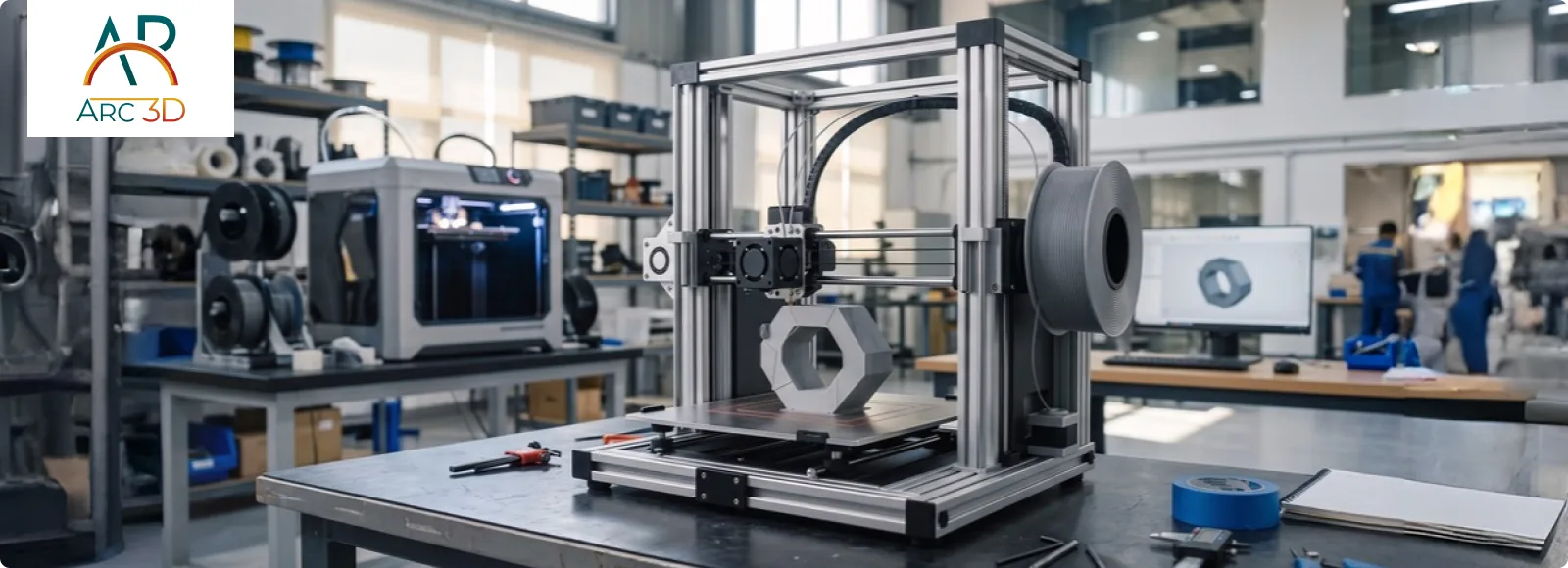
What Is 3D Printing?
The 3D printing is also called additive manufacturing. Feed it a digital file and it grows the object upward one slice at a time, each slice somewhere between 0.05mm and 0.3mm. Picture stacking sheets of paper to make a shape. You get lovely detail out of it, but you pay for that in passes. Hundreds of them. Sometimes thousands.
How Long Does 3D Printing Take? Average Printing Times
The average time it takes is purely depending on what your project type and requirement is. Sometimes it can be completed in a few hours and some can take 2 to 3 days, as we said it all depends on your project. Geometry, material and finishing can all push a job outside them.
Small Simple Parts
A bracket, a fitting, a little display piece. Basic shape, plain finish. It will approx. take 1 to 4 hours. These are the jobs where the estimate rarely surprises anyone.
Medium-Complexity Prototypes
Got a functional prototype with a fair amount of detail? Or a mid-size presentation model? The medium complexity prototypes will take approx. 4 to 24 hours of print time. The printer can run by itself the whole way, but somebody has to plan and set up the job first, and there's work to do after it stops.
Large or Detailed Projects
This is where we're talking about days. Masterplan models, multi-part assemblies, industrial parts with tight tolerances can need several days of printing alone, then finishing on top of that. Some examples on what ARC 3D has worked on: a fully 3D-printed moving cutaway model of a T700 turboshaft engine for a defence company, an architectural factory model with interiors for Al Ghurair, an illuminated masterplan model for the Hatta development project. None of that comes off the printer ready to hand over and sometimes it's handcrafted as well but it depends on how much is the detailing work. Defence, real estate and aerospace use this kind of work heavily, and they're a big part of industries using 3D printing in Dubai.
Key Factors That Affect 3D Printing Time
Some of these you can change and some you're stuck with, but it helps to know which is which before the file goes in. The main factors affecting 3D print time:
- Part size and volume. Bigger parts need more material and more layers. Time rises faster than size, too, because large builds need extra cooling and recoating.
- Geometric complexity. Flat walls are quick. Curves, internal channels, undercuts, not so much, and some technologies add supports to handle them.
- Layer height. Smoother finish, longer wait. Drop from 0.2mm to 0.1mm and the same part can take roughly twice as long, since the printer is making twice as many passes.
- Infill density. Parts usually aren't solid inside. Denser infill uses more material on every layer, so it takes longer.
- Support structures. In FDM and SLA, overhangs need temporary supports, which cost time to print and again to remove. SLS gets by without them.
- Post-processing. Sanding, painting, assembly, and lighting on some models. It's not print time, but it's production time, and a raw print and a finished presentation model from one file can be days apart.
FDM vs SLA vs SLS: How Technology Changes Print Time
Part of the reason "how long does a 3D print take" has such a variable answer is the technology used. Each method has its own printing speed, and the fastest option depends on what you're making. Understanding FDM vs SLA vs SLS 3D Printing can help you choose the right technology for your project's time, material, and quality requirements.
FDM: Fused Deposition Modeling
Thermoplastic filament gets melted in a heated nozzle and laid down layer by layer. FDM 3D Printing is good for large structural parts and big build volumes. Fine detail slows it down. The filament choice is wide, too: PLA, ABS, PETG and Nylon are on the list at ARC 3D, along with carbon-fiber reinforced filaments and ETPU.
SLA: Stereolithography
A UV laser cures liquid resin. For big solid parts, it's slower than FDM. But the surface is so smooth that FDM would need serious sanding to match it, so on small detailed parts, SLA 3D Printing can end up faster overall because there's less cleanup afterward. At ARC 3D, the resins are Standard, Clear, Engineering, Castable and Biocompatible.
SLS: Selective Laser Sintering
A laser fuses nylon powder, and there are no supports to deal with. SLS 3D Printing is good for complicated geometry and batches too, because you can pack several parts into the powder bed and print them together. The slow part is cooling once the build finishes. ARC 3D's SLS options include PA12, PA11, Glass-Filled Nylon and flexible TPU powder.
How Does Material Choice Affect 3D Printing Time?
We tend to treat material as a strength decision. But it quietly changes the schedule too, both while the machine is running and in the cleanup afterwards.
A few examples make it less abstract. Choose an engineering resin for an SLA part and the laser spends longer on every single layer than it would with a standard resin, which adds up quickly on a tall part. ABS is a fussier pick than PLA in FDM. It prints hotter and needs a heated enclosure or the part warps, and managing that slows the deposition rate. Nylon pulls moisture out of the air, so don't be shocked if it goes through a drying step before printing. And carbon-fiber filaments? Hardened nozzles, plus speed settings you won't find on a standard profile.
My advice: if the deadline is tight, pick the material when you write the brief. Leaving it until the file's already been prepped just adds back-and-forth. This guide on how to choose the right 3D printing material is a decent place to begin.
Print Time vs Total 3D Printing Turnaround Time
Print time is whatever the machine logs. What matters for your calendar is 3D printing turnaround time, and the delays almost always hide in the gap between the two numbers.
It's like cooking dinner: the oven timer only covers one part of getting food on the table. ARC 3D's portfolio shows it too, with models that have moving parts and built-in lighting, where the printer is just one stage. Here's how the process goes, in four steps:
- Share your project. Send the brief, size, material preference, quantity and what the part's for.
- Upload your design. Add the 3D file or project brief, and the team checks it can be printed before production.
- Receive your quote. Clear pricing and a timeline confirmed against the real scope.
- Printing and delivery. The part gets made and inspected, then delivered across Dubai and the UAE.
None of the file review, material prep, finishing, inspection and delivery shows up on the print timer, and all of it takes time. The fix is boring but it works: give a full brief at the start, and when the team goes to estimate 3D print time, you get a real number instead of a hopeful guess.
Why Choose ARC 3D for Custom 3D Printing in the UAE?
ARC 3D works out of Musaffah Industrial Area in Abu Dhabi and takes on custom 3D printing for clients across Dubai, Abu Dhabi and the rest of the UAE. In the last four years, the team has manufactured more than 50,000 parts for around 2,000 customers across ten nations, which is a lot of parts. Everything is done in-house, from SLA and FDM to SLS, so the team is able to use the process that fits the project well.
The team says every project starts with listening. That might sound like marketing talk, and fair enough. In practice it saves time. A part built for a client presentation and a part that has to work as a component need different processes and materials, and settling that early keeps the schedule from shifting later.
The client mix is wide. Over 16 industries, from architecture and defence to marine, oil and gas, healthcare, aerospace, jewellery and consumer goods. The portfolio runs from a specialised oil and gas operational model built for the National Guard to a large-scale Hulk figure, one example of how 3D printing brings cosplay characters to life. Partners include the Ministry of Defence, Al Ghurair, Miral, Emaar and Modon. And it's not only printing. They also do 3D scanning and reverse engineering, rapid prototyping, large-scale and architectural model making, plus interactive extras like AR, VR and touchscreens. Doing it all in-house gives them tighter control over accuracy and quality, with structured quality control from file review through to delivery.
They quote timelines after looking at your actual file and scope. No generic placeholders. If your deadline can't move, ask for exactly that kind of quote, because a 3D printing turnaround time worked out from your real file beats a guess every time.

Conclusion
There's no clean answer to "how long does 3D printing take," and anyone who gives you one without seeing your file is guessing. Small parts are a matter of hours. Big or fiddly ones run into days, and moving parts or lighting add more on top. The main thing to take away is to write the brief properly. An inadequate brief is the source of many unpleasant surprises, while a proper one gives you a full 3D printing estimate. ARC 3D does all processing types like SLA, FDM, and SLS in-house, which means that the correct technology is selected for your next project; now it is a matter of saying what you need and when you need it.