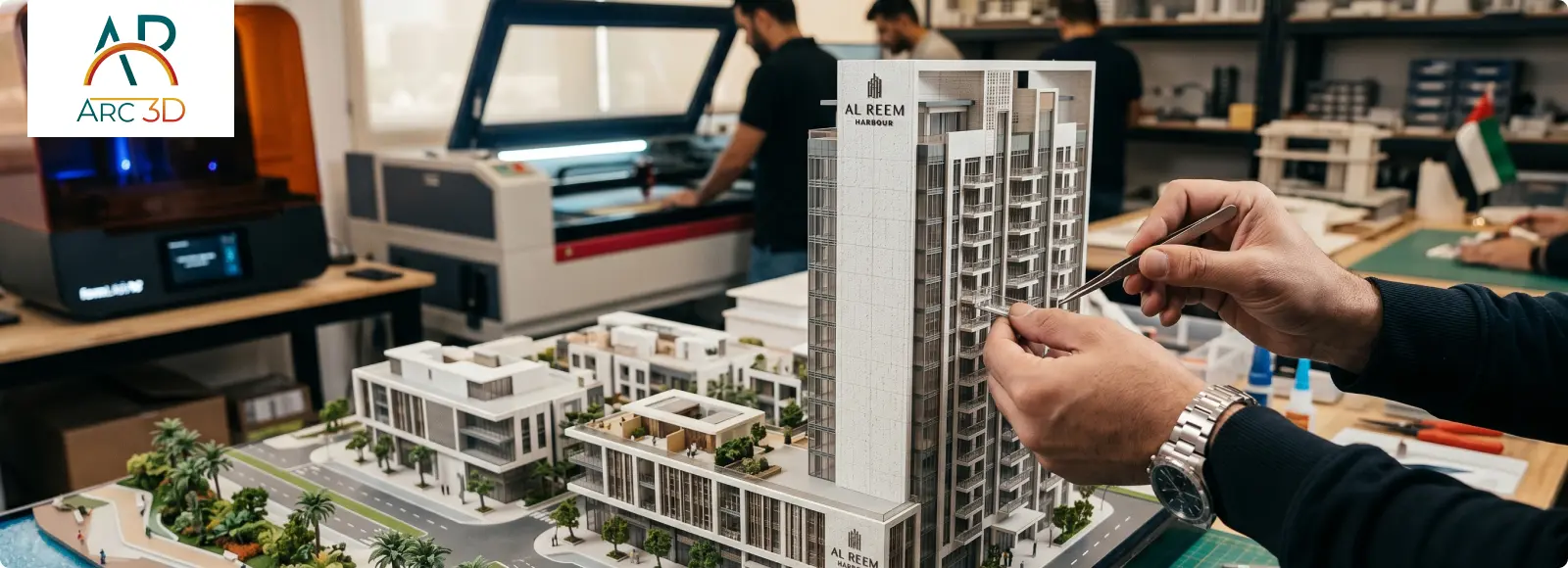
ARC 3D delivers high-quality architectural model making service in UAE through an end-to-end in-house process combining 3D printing, CNC machining, and hand craftsmanship across five model types serving developers, government bodies, and engineers across Dubai and Abu Dhabi.
A well-executed architecture model communicates scale, design intent, and spatial reality in a way no screen-based render can match. It gets walked around. Pointed at. Understood by people who have never read a floor plan.
In the UAE, where development moves fast and the rooms these models end up in carry real weight, the quality of the physical model on the table is a strategic decision, not a production formality.
This blog covers what high-quality architectural model building actually involves. The materials, the technologies, the process, and the standards that separate a model that wins rooms from one that raises questions.
Why High-Quality Architectural Models Matter in UAE Projects
Not every market puts the same pressure on physical models. The UAE does.
Developers here are selling units before foundations are poured. Architects are presenting to government authorities on fixed review dates. Planners are making the case for master plans in rooms full of decision-makers who won't read a 300-page document. In every one of those situations, the architecture model on the table is doing more work than anyone in the room explicitly acknowledges.
Architectural scale models convert buyers. A physical model in a sales centre lets someone see exactly where their apartment sits relative to the pool, the park, and the entrance. That spatial understanding is what moves a conversation from interest to commitment. Renders approximately. A well-built model delivers it.
For government approvals and urban planning reviews, a masterplan model makes complex zoning and infrastructure relationships immediately clear to people who aren't reading technical drawings. For investors evaluating a hospitality or mixed-use development before committing capital, the model communicates ambition and delivery confidence at the same time.
Architectural model making in Dubai and Abu Dhabi operates within a calendar of fixed deadlines. Cityscape. Defence expos. Launch events. Government review windows. None of those dates flex. A model that isn't ready, or isn't good enough, doesn't just create a problem at that specific moment. It pushes back everything downstream.
The quality bar isn't set by preference. It's set by the context the model lands in.
ARC3D's Approach to Architectural Model Excellence
Most studios produce models. The ones worth working with produce models built around the specific outcome the client needs, not just the dimensions in the file.
ARC 3D's approach starts before fabrication begins. It starts with understanding what the model is for, who will be in the room when it's presented, and what that audience needs to take away from the experience. A model for a government approval review has different priorities from one built for a luxury real estate launch. A masterplan model for an exhibition has different demands from a detailed interior model for a hospitality sales centre.
That understanding shapes material selection, technology choices, finishing standards, and the level of detail applied at every stage. It's the difference between a model that technically fulfills the brief and one that actually performs in the room.
ARC 3D's specialisation in custom and complex commissions is built on exactly this. Standard briefs get handled efficiently. The ones that require unusual combinations of technologies, non-standard scales, interactive elements, or very short turnaround windows get handled with the same depth because the team has encountered enough variation to know how each type of challenge resolves.
Before any 3d model architecture commission leaves the studio, it gets checked against dimensional accuracy traced back to the original drawings, durability for the full lifecycle of use, including transport and extended exhibition periods, and finishing quality that holds up under close inspection in the lighting conditions of the room it was built for. Not one of those standards gets traded off against the others.
Step-by-Step: ARC3D Architectural Model Making Process
The process is where the quality standard gets either protected or lost. Here is how it runs across four confirmed stages on every ARC 3D commission.
Stage 1: Consultation and Concept
2D drawings, CAD files, Revit models, or masterplan documents get reviewed in full before any fabrication decisions are made. Scale is confirmed. Presentation context is established. Architectural model making materials and technology combinations are selected based on what the model needs to do, not just what's available. A 3d architectural model maker who does this properly at the start prevents the production problems that appear mid-build when assumptions go unchecked.
Stage 2: Digital Blueprinting
A 3D digital model is prepared for client review before physical production begins. This checkpoint exists for one reason: catching changes while they're cheap. A revision identified at the digital stage costs hours. The same revision identified after CNC cutting and printing has started costs days and materials. Clients who use this stage decisively keep their timelines intact.
Stage 3: Model Fabrication
Production runs across multiple processes at the same time. Arc3D 3D printing services handle facades, intricate components, and transparency effects. CNC milling and laser cutting handle base structures, topography, and repetitive elements. Hand craftsmanship handles landscaping, texturing, and bespoke finishing. Lighting systems and interactive elements get integrated during fabrication. This is where the bulk of the architectural model making timeline lives and where the decisions made at Stages 1 and 2 either pay off cleanly or create complications
Stage 4: Finishing, Quality Check, and Delivery
Paint, assembly, and inspection all happen in-house. Nothing in this stage is outsourced. Packaging is purpose-built per model. Large-format commissions are built in modular sections specifically for safe transport and on-site assembly across Dubai, Abu Dhabi, and the rest of the UAE.
Technologies Used by ARC3D to Ensure Precision
Walk into an ARC 3D commission and you'll notice something quickly. Not every part of a model comes off the same machine. A building facade with fine window detail is printed differently from the base platform it sits on. The landscaping around it is applied by hand. The technology behind each component is chosen based on what that specific element needs to do. For 3d printed architecture models, that selection process is what separates a model that holds up in a room from one that falls apart on closer inspection. Here are the three printing technologies ARC 3D runs in-house and what each one actually contributes to an architectural model making project.
SLA (Stereolithography)
SLA printing technology works by using a UV laser to cure liquid resin into solid form, layer by layer. The output is smooth, detailed, and precise in a way that the other methods don't match. Window mullions, ornamental facade elements, curved surfaces, transparent glazing effects, these are the kinds of components SLA handles best. The surface comes off the machine ready to paint, which matters on a model where every visible detail reflects directly on the development it represents.
For 3d architectural model making services that require presentation-quality finishes, SLA is where most of the facade work ends up. ARC 3D runs it across five resin types: Standard, Clear, Engineering, Castable, and Biocompatible, covering everything from sales centre display pieces through to specialist applications in healthcare and defence. Where it has limits is in structural performance. SLA resin is brittle under mechanical stress, so it doesn't work well for components that need to survive rough handling or repeated transport. For what it's designed to do, though, nothing else comes close when the detail level matters.
FDM (Fused Deposition Modeling)
FDM printing technology builds parts by melting thermoplastic filament and depositing it layer by layer through a nozzle. The surface isn't as refined as SLA, but the material range is significantly broader, and for an architectural model building project, that breadth matters. ARC 3D's FDM material options include PLA, ABS, PETG, Nylon, Carbon-Fiber Reinforced Filaments, and ETPU for flexible applications.
What this means in practice is that base structures, internal supports, large flat sections, and components that will be handled, transported, and set up repeatedly are all better suited to FDM than to either of the other two technologies. A model that gets packed, shipped to an exhibition in Dubai, unpacked, displayed for three days, repacked, and sent back to Abu Dhabi needs structural material that can take that cycle. These are the architectural model making materials that keep the model in one piece long after the first presentation. Cost-accessible too, which matters when sections of a large scale model making need to be reproduced or replaced.
SLS (Selective Laser Sintering)
SLS printing technology uses a laser to fuse powdered nylon into solid parts. The single most important thing about it is that it doesn't need support structures during printing. For most 3D printing processes, complex internal geometry, undercuts, and interlocking parts are a problem. With SLS, they're not. The powder itself supports the part while it's being built, which means geometries that simply aren't achievable with SLA or FDM become printable.
ARC 3D runs SLS in PA12, PA11, Glass-Filled Nylon, and flexible TPU powder. Strong, dimensionally accurate, and suited to industrial and technically demanding commissions. For 3d modeling services architecture projects that include complex structural components, moving parts, or elements where geometric precision has to hold under load, SLS is where the work ends up. The cost sits higher than FDM or SLA, which is why it gets selected specifically for the components that justify it, rather than applied across an entire model.
Learn More: Selective Laser Sintering (SLS): A Complete 3D Printing Guide
Types of Architectural Models Delivered by ARC3D
Five main model types cover the range of what ARC 3D commissions. Each one serves a specific purpose and carries different production requirements. Here is what each type is built for and which clients typically commission it.
Architectural Scale Models
Architectural Scale Models are high-accuracy representations of individual buildings or structures. Used for real estate sales, investor meetings, and government approval presentations. Precise geometry, accurate proportion, professional finish. The standard commission for a developer bringing a new project to market.
3D Scale Models
3D Scale Models are built primarily through digital production and 3D printing processes. Used for exhibitions, marketing campaigns, and project reviews where speed and detail need to work together. Technology-driven production supports tight marketing timelines without sacrificing surface quality.
Masterplan Models
Masterplan Models are the most complex category. Large-format representations of entire developments including roads, zoning, landscaping, infrastructure, and phasing. Government bodies, urban planners, and major developers commission these for launches and long-term planning presentations. The scale and detail requirements sit in a different category from any other model type.
Learn More: 3D Architectural Masterplan Model: Complete Guide for UAE Modern Project Development
Detailed Interior Models
Detailed Interior Models show room layouts, material finishes, furniture arrangements, lighting design, and spatial flow at close range. Hospitality projects, retail environments, high-end residential developments. The interior detail level distinguishes these from standard scale commissions.
Industrial and Technical Models
Industrial and Technical Models cover factory layouts, machinery installations, oil and gas plants, and engineering systems. Accuracy is the priority. These models support presentations, training programmes, and approval documentation for engineering and industrial clients.
Learn More: Different Types of Architectural Models
How ARC3D Supports UAE Developers, Architects & Planners
If you are looking for the best architectural model makers in the UAE, then ARC 3D is the right destination for you. ARC3D serves a wide range of industries and project types, going beyond the traditional scope of architectural model making. With expertise across four key application areas, ARC 3D delivers highly detailed and purpose-built models tailored to specific project requirements, industry standards, and client objectives. This versatility enables them to create accurate, high-quality architectural models for a diverse range of sectors throughout the UAE.
Real estate and property sales are the highest-volume context. A physical model in a sales centre communicates what a buyer needs to feel confident before committing. Emaar, confirmed on ARC 3D's site as a client, uses architectural model making in Dubai specifically as a buyer conversion tool. The model communicates the masterplan clearly enough that buyers understand their unit's position, orientation, and relationship to amenities without needing a sales consultant to interpret it for them.
Urban planning and government projects rely on masterplan models to make large-scale development proposals reviewable by non-technical audiences. Zoning, infrastructure, environmental relationships. A physical model makes these readable at a single glance in a way that plans and documents don't.
Hospitality and tourism clients present hotel developments, resort masterplans, and attraction layouts to investors and operators. The physical model is usually the most important single asset at a pitch.
Engineering and industrial organisations use technical models for training, safety planning, and approval documentation. A physical representation of a plant or factory layout gives teams a three-dimensional understanding of spatial relationships and workflows that drawings on paper don't provide.
Real Project Impact: How High-Quality Models Help Clients
The value of a well-built architecture model shows up most clearly in the outcomes around the table, not in the model itself.
Developers who commission quality models for sales launches report faster buyer decision cycles. The model removes the interpretive work from the buyer's side. They don't need to picture it. They can see it. That shortens the sales conversation and reduces the number of objections that come from spatial uncertainty.
Government authorities reviewing development proposals engage more directly with a physical model than with a screen-based presentation. A masterplan model on a table invites pointed, specific questions that lead to faster approvals rather than deferred decisions.
Investors evaluating projects before committing capital use the model to assess execution confidence as much as design quality. A precisely built, professionally finished model signals that the developer and their team are operating at a level of detail that extends beyond the presentation itself.
ARC 3D's custom commissions for clients including the Ministry of Defence, Emaar, Miral, SeaWorld Abu Dhabi, Modon, and Civil Defence Abu Dhabi span all of these contexts. The consistent thread across those clients is that the model they needed wasn't a standard output. It was a specific, custom-built piece that had to perform in a high-stakes room without falling short on any dimension.
That specialisation in custom orders and complex briefs is what makes the difference between a model that does its job and one that quietly undermines the project it was built to represent.
Why ARC3D is a Trusted Architectural Model-Making Company in the UAE
For developers, architects, planners, and engineers working across Dubai and Abu Dhabi, the right architectural model-making company is the one with in-house capability across every production method, genuine experience on complex and custom commissions, professional finishing applied in-house, and transparent pricing confirmed after reviewing the actual brief.
ARC 3D serves clients across Dubai, Abu Dhabi, and the wider UAE as a professional architectural model-making company across 16-plus industries. Their portfolio of 10 major government and enterprise partners includes Emaar, Modon, Ministry of Defence, Miral, SeaWorld Abu Dhabi, Al Ghurair, AMMROC, GAL, and Civil Defence Abu Dhabi. Organisations where quality and delivery reliability carry equal weight.
3D printing, CNC machining, laser cutting, hand craftsmanship, lighting integration, and interactive elements all run under one roof. No outsourcing, no quality handoffs, no delays waiting on third parties. The standard in the portfolio is the standard delivered to every client.
As one of the leading architectural model makers in UAE, their specialisation in custom orders and technically demanding commissions is what makes them the right partner when the brief is specific, the deadline is fixed, and the room the model lands in carries real weight.
To start a project, contact ARC 3D, Share your drawings, scale requirements, and delivery deadline. The team will take it from there.

Final Thoughts on Architectural Model Making in the UAE
Architectural model making is not a production formality at the end of a design process. It's a strategic asset that shapes how a project is received by the people who matter most.
Getting it right means architecture model materials matched to the intended use, the right technology mix for the required detail level, and a production process rigorous enough to protect accuracy from brief to delivery. When those elements work together, the model does what it was built to do.
In the UAE's development market, where the room an architecture model lands in rarely gives second chances, working with a professional architectural model-making company that has in-house capability across every production method, genuine specialisation in custom and complex commissions, and a portfolio built on the UAE's most demanding clients isn't optional. It's the decision that protects the project.
ARC 3D's architectural model making in Dubai and Abu Dhabi is built for exactly this. Complex, custom commissions handled in-house from brief to delivery, by a team with the expertise to get every stage right.
Start the conversation with the ARC3D expert team.