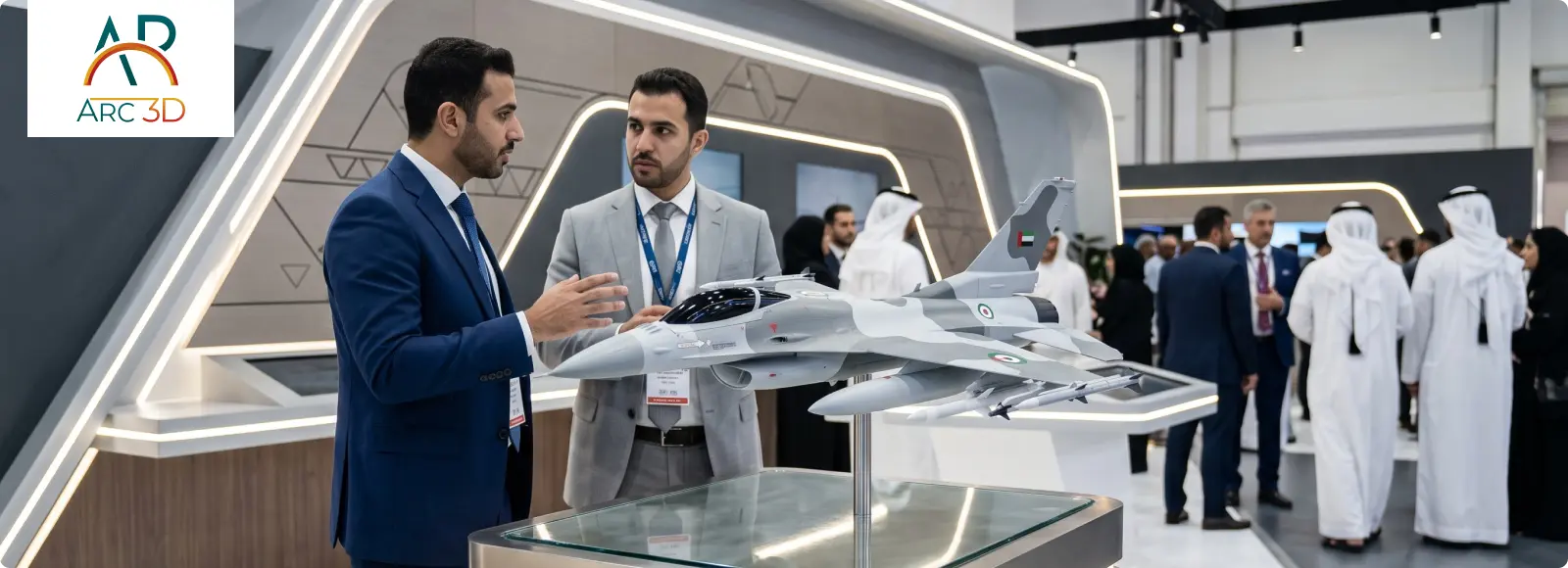
A physical model can.
An efficient 3D model printing service provides an opportunity for visualization to all stakeholders of an aircraft, naval craft, armored vehicle, drone or defense equipment from different angles. Moreover, with the help of cutouts or some interactive features, a 3D model can make it easier to show intricate details of a given product that cannot be demonstrated on the screen.
This issue is especially important for the UAE, which hosts many exhibitions in the field of defense, where manufacturers, government bodies, purchasing departments, engineers and international delegations gather.
One of such events is IDEX, the International Defence Exhibition & Conference, which takes place in Abu Dhabi and covers defense industries related to land, air and sea. The event, held simultaneously with the IDEX exhibition, is called NAVDEX, which is dedicated exclusively to naval defense and maritime safety. In 2025, the IDEX exhibition hosted over 206,000 visitors, 1,565 exhibitors and representatives of 65 countries.
In this regard, it is important that each company engages in the physical presentation of the product being sold.
Quick Answer: 3D printed defence models help exhibitors explain complex platforms in a simple, visual way. They can show scale, external features, internal systems and individual components while also giving visitors something physical to examine and discuss.
What Are 3D-Printed Defence Exhibition Models?
A defence exhibition model is a scaled physical representation of a military platform, vehicle, vessel, aircraft, system or component.
The format depends on what the company wants visitors to understand.
It could be:
- A fighter aircraft or helicopter
- An unmanned aerial vehicle
- An armoured vehicle
- A naval vessel
- An engine cutaway
- A radar or other subsystem
- A detailed component shown at an enlarged scale
- A working or moving demonstration model
The model is not simply a smaller copy of the original.
Its real purpose is to make the product easier to explain.
For example, an aircraft model can show the overall shape and configuration. A cutaway can expose the internal arrangement. An enlarged component can bring attention to a technical feature that would otherwise be too small to see.
That is where 3D printed military models become useful on a busy exhibition floor.
Benefits of Using 3D Printing Instead of Traditional Model Making
Traditional model making can involve a great deal of manual work. That is not necessarily a problem, but it can become difficult when an exhibition date is approaching or a design changes late in the process. The wider 3d printing in the defence industry is also changing how companies approach prototyping, tooling and product development. Exhibition models are a smaller part of that picture, but the same advantage applies here: a digital design can be turned into a physical object without starting the entire model-making process from scratch.
3D printing gives exhibitors more room to work.
Faster production
Once the digital design is ready, parts can move into printing without building every section manually.
This is useful when the exhibition date is fixed and the model needs to be completed within a specific window.
Consistent detail
A digital model can be reproduced with controlled dimensions and fine surface features. Panel lines, curves and other details can be incorporated into the design before production begins.
Easier revisions
Defence programmes can change during development. If one section of the platform is updated, the corresponding digital file can be modified and that section can be produced again.
The entire model does not necessarily have to start over.
Repeat production
If a company needs the same model for different exhibitions, offices or presentations, the original digital file can be used again.
That makes 3D printing particularly practical for companies that attend multiple events.
Learn More: Large Scale 3D Printing in Dubai: Applications, Benefits & Limitations
Types of Defence Models Used at UAE Exhibitions
One model does not have to do every job on a defence stand. Choosing the right 3D model solution helps defence companies present complex equipment with greater clarity and create a stronger impact at UAE exhibitions.
Scale platform models
These are the models most visitors recognise immediately.
Aircraft, helicopters, vessels, armoured vehicles and drones can all be reproduced at a scale that fits within the exhibition space.
A naval platform, for instance, may be too large to display inside a hall. A scale model allows visitors to see the vessel's overall design while the actual platform can be displayed separately where possible.
Exhibition Booth Models
Not every model needs to represent a complete defence platform. An exhibition booth 3d model can also be used as a central display element, combining a platform, product components and branding within the stand itself.
This approach works particularly well when the exhibitor wants the model to attract attention from a distance while still giving visitors something detailed to examine up close.
Cutaway models
Cutaways are useful when the internal design is part of the story.
An engine, crew compartment, propulsion system or other mechanism can be opened up so visitors can see how the different parts fit together.
For technical discussions, that can be more useful than a conventional exterior model.
Component models
Sometimes the product being presented is a specific component rather than an entire platform.
An enlarged component can make small engineering details much easier to discuss with visitors.
Interactive models
Some exhibition models incorporate lighting, moving parts, touchscreens or augmented-reality elements.
These additions are not necessary for every project. They make sense when interaction helps explain something that a static model cannot.
How 3D Printing Improves Defence Product Demonstrations?
Consider how difficult it can be to explain a complex aircraft or naval system using only slides.
This is the reason 3d printing in defence has more value beyond just a simple prototyping and manufacturing. With the help of a physical model you can show engineers and visitors something which actually exists and not just on papers.
A physical cutaway gives the visitor something they can look at while the conversation is happening.
They can see where a component sits. They can follow the relationship between systems. They can compare the external shape with what is inside.
That makes physical models particularly useful for explaining:
- Internal layouts
- System placement
- Platform proportions
- Component relationships
- Design features
- Different configurations
At events such as IDEX, where exhibitors meet government representatives, defence professionals and international delegations, that immediate visual understanding can make a technical conversation easier to start.
The model does not replace the engineer or sales team. It gives them something useful to talk about.
Key Features of High-Quality Defence Exhibition Models
A model can be technically accurate and still look disappointing on the stand.
A strong exhibition model usually gets four things right.
Accuracy
The proportions and visible details should match the approved design. For a knowledgeable audience, small inaccuracies can be noticed quickly.
Clear presentation
The visitor should be able to understand what they are looking at without having to search through a crowded display.
Finish quality
Printing creates the basic part. Finishing gives it a presentation-ready appearance.
Depending on the project, this can include sanding, priming, painting, decals, panel details and protective coatings.
Practical construction
The model may have to travel, be assembled, displayed for several days and then transported again.
It should therefore be designed with handling and transport in mind from the beginning.
3D Printing Technologies Used for Defence Exhibition Models
Different parts of a defence model can benefit from different printing technologies.
SLA
SLA 3D printing uses liquid resin cured with light. It is useful where smooth surfaces and fine visible details are important.
SLS
SLS 3D printing uses powdered material to produce complex parts without conventional support structures. It can work well for intricate components and parts where strength is important.
FDM
FDM 3D printing builds parts from thermoplastic filament, layer by layer. It is often a practical option for larger sections where production cost, size and time all need to be considered.
A large aircraft model, for example, does not necessarily need to be printed using one process from beginning to end. FDM may be suitable for larger structural sections, while SLA or SLS can be used where finer detail or more complex geometry is required.
The right combination depends on the model.
Learn More: FDM vs SLA vs SLS 3D Printing: Which Technology Should You Choose for Your Project?
Materials Used for Defence 3D Printed Models
Material choice also depends on what each part needs to do.
Common options include:
- Resins for detailed visible parts
- Nylon for durable components
- Thermoplastics for larger structural sections
- Engineering-grade materials where higher mechanical performance is required
Printing is only the first stage.
The finished model may also need paint, decals, surface detailing, lighting or protective coatings. A model that will travel to several exhibitions needs to be finished with transport and repeated handling in mind.
Industries That Use Defence Exhibition Models
An exhibition model can continue to be valuable long after the event. The same skills used for defence displays also have applications across 3D printing in aerospace and defence, particularly when companies need physical representations of aircraft, engines, components, or complex assemblies. Working with custom model makers in Dubai ensures these models are accurate, durable, and suitable for exhibitions, client presentations, and training purposes.
Companies may use the same model for:
- Product demonstrations
- Internal design reviews
- Procurement meetings
- Government briefings
- Training
- Aerospace presentations
- Museum or heritage displays
- Marketing and video production
This is one reason a well-planned model can offer more value than a one-time exhibition prop.
A model produced for IDEX or NAVDEX may later be used in a meeting room, training environment or another exhibition.
Learn More: 10 Industries Using 3D Printing in Dubai and the UAE
How to Choose a 3D Printing Partner for Defence Models?
Price is only one part of the decision.
For defence-related models, it is worth checking:
Technical capability: Can the company handle the required scale, geometry and level of detail?
Materials: Can it recommend suitable materials instead of using the same material for every part?
Finishing: Does it handle painting, decals, assembly, lighting and other finishing work?
Turnaround: Can the production schedule realistically meet the exhibition deadline?
Experience: Has the team worked on technically demanding defence or aerospace models?
Confidentiality: Can project files and sensitive design information be handled appropriately?
A provider that can manage design, printing and finishing under one roof can also make coordination easier, particularly when the deadline is tight.
Why Choose ARC 3D for Defence Exhibition Models in the UAE?
ARC 3D provides 3D printing and model-making services in the UAE, covering areas such as design, printing, finishing and interactive model development.
The company has worked on defence and aerospace-related projects, including a moving T700 Turboshaft Engine cutaway model for a UAE defence client.
A project like this involves more than printing individual parts. The source design needs to be understood first. The model has to be divided into suitable sections, the right printing processes need to be selected, and the finished components have to come together as one coherent display.
For companies preparing for IDEX, NAVDEX or other defence exhibitions in the UAE, having these capabilities handled through one team can simplify the production process.

Conclusion
A defence exhibition model has a straightforward purpose: make a complicated product easier to understand.
3D printing helps make that possible with less manual production work and more flexibility when designs change. Scale models can show an entire platform. Cutaways can reveal what is inside. Enlarged components can make small technical features easier to discuss.
At major UAE defence events such as IDEX and NAVDEX, where companies are presenting to international delegates, government representatives and industry professionals, that visual clarity can be valuable.
The result depends on more than the printer itself. Scale, material, accuracy, finishing and presentation all have to work together.